Why Dog Dental Disease Is More Common Than Most Owners Realise
Dog dental disease explained in brief: it is a progressive bacterial infection of the teeth, gums and surrounding bone that affects the majority of adult dogs, often without obvious signs until significant damage has already occurred.
Quick overview:
- What it is: Bacterial plaque builds on teeth, hardens into tartar and triggers inflammation of the gums (gingivitis) and deeper structures (periodontitis)
- How common: Over 80% of dogs show signs of dental disease by age three
- Key risk: Most damage happens below the gum line, where it is invisible without professional examination
- First sign: Bad breath (halitosis) is typically the earliest warning owners notice
- Why it matters: Untreated disease can lead to tooth loss, chronic pain and bacterial spread to major organs including the kidneys, liver and heart
- What helps: Daily tooth brushing, VOHC-accepted dental products and regular professional veterinary cleanings
Dental disease is consistently ranked among the most common conditions seen in veterinary practice in South Africa and globally. Yet many dog owners only become aware of a problem once their dog is already in pain or showing visible symptoms like loose teeth or facial swelling.
The challenge is that the most destructive phase of the disease happens silently, beneath the gum line, where no amount of visual inspection at home can detect it.
This guide covers how dental disease develops, what signs to watch for, which dogs are most at risk and what you can do to slow or prevent its progression.
I am Sharon Milani, Co-Founder and Director of NutriFlex® and developer of DentaMax™, a 100% pure organic Ascophyllum nodosum dental powder formulated to support systemic plaque and tartar reduction in dogs. My work in evidence-based pet nutrition and oral health supplementation directly informs this practical guide to dog dental disease explained, with a focus on prevention strategies relevant to South African dog owners.
Dog Dental Disease Explained: From Plaque to Periodontitis
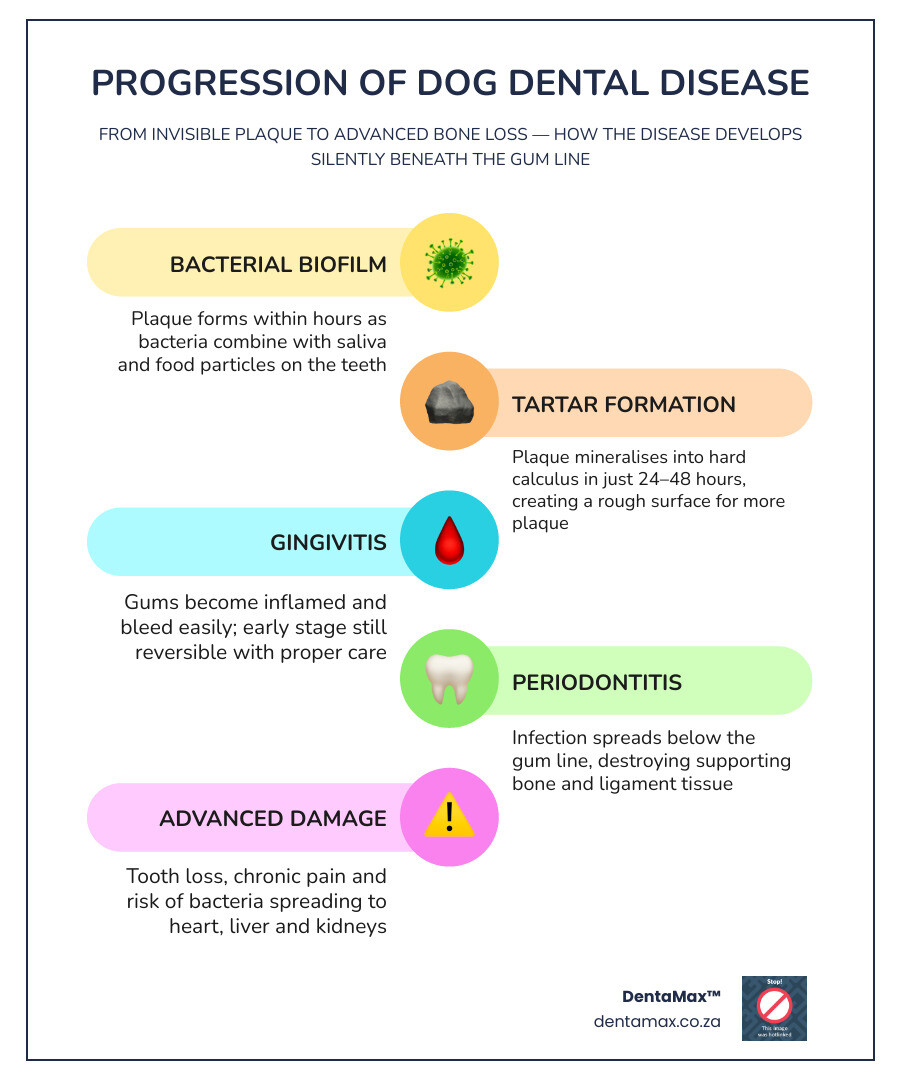
To understand how dental disease takes hold, we must look at the microscopic world inside a dog’s mouth. It all begins with a bacterial biofilm known as plaque. Within hours of eating, bacteria naturally present in the mouth combine with saliva and food particles to form a sticky, colourless film on the teeth.
If this plaque is not mechanically disrupted through brushing or chewing, it begins to mineralise. In dogs, this process happens incredibly fast. Plaque can start to harden into tartar (also called calculus) within 24 to 48 hours. Once tartar has formed, it creates a rough, porous surface that acts like a magnet for even more plaque.
This cycle leads to inflammation. Initially, the bacteria irritate the gum tissue, leading to gingivitis. If left unaddressed, the infection migrates deeper, attacking the periodontal ligament and the alveolar bone that holds the tooth in place. This advanced stage is known as periodontitis. According to the Dental Disorders of Dogs – MSD Veterinary Manual, periodontitis is a primary cause of tooth loss in adult dogs.
Understanding how dental disease develops in dogs is the first step in stopping it. Unlike humans, dogs rarely get “cavities” or caries (which account for less than 10% of canine dental issues). Instead, their struggle is almost entirely with the tissues surrounding the tooth.
Understanding the Stages of Dog Dental Disease Explained
Veterinary professionals categorise the progression of oral health issues into four distinct stages. Recognising where your dog stands is vital for determining the necessary treatment.
- Stage 1: Gingivitis This is the only reversible stage. You will notice a thin red line along the gum margin and perhaps some mild bad breath. There is no bone loss yet. Professional cleaning and improved home care can return the mouth to a healthy state.
- Stage 2: Early Periodontitis At this stage, the attachment between the tooth and the gum begins to break down. We typically see up to 25% bone loss on dental radiographs. The gums may appear swollen or bleed easily.
- Stage 3: Moderate Periodontitis Bone loss progresses to between 25% and 50%. “Pockets” form under the gum line, trapping bacteria and debris. This stage is painful and usually requires advanced dental procedures to save the teeth.
- Stage 4: Advanced Periodontitis This is the most severe stage, with more than 50% bone loss. Teeth are often loose, covered in heavy tartar and may even fall out. The risk of systemic infection is at its highest here.
For a deeper dive into these clinical markers, you can explore our guide on Canine Periodontal Disease Stages.
Recognising Signs and Professional Treatment
Dogs are masters at hiding pain. This is an evolutionary survival instinct; showing weakness in the wild makes an animal a target. Consequently, many South African pet owners assume that because their dog is still eating, their mouth must be fine. In reality, a dog with Stage 4 disease will often continue to eat because the drive to survive outweighs the chronic ache in their jaw.
Common signs that require a veterinary visit include:
- Persistent halitosis (bad breath)
- Red, swollen or bleeding gums (check for blood on chew toys)
- Yellow or brown tartar deposits
- Excessive drooling or dropping food while eating
- Pawing at the mouth or face
- Nasal discharge or sneezing (which can indicate a tooth root abscess)
Beyond the mouth, we must consider the systemic impact. When the gums are inflamed and infected, the barrier between the oral bacteria and the bloodstream is compromised. This allows bacteria to enter the circulatory system, a condition called bacteremia. These bacteria can travel to and colonise vital organs. Research suggests a strong link between advanced periodontal disease and damage to the heart valves, liver and kidneys. Understanding how oral bacteria affect dog health highlights why dental care is a pillar of overall longevity.
According to the Periodontal disease | Cornell University College of Veterinary Medicine, professional treatment is the only way to address established disease.
Professional Veterinary Cleaning vs Anaesthesia-Free Scaling
There is a growing trend in some South African grooming parlours offering “anaesthesia-free” dental cleaning. We must be very clear: this is a cosmetic procedure only and does not treat dental disease.
| Feature | Professional Vet Dental (With Anaesthesia) | Anaesthesia-Free “Cleaning” |
|---|---|---|
| Sub-gingival Cleaning | Yes, cleans the 60% of the tooth below the gum line | No, only scrapes visible tartar |
| Pain Control | Yes, full pain management provided | No, can be stressful and painful |
| Radiographs (X-rays) | Yes, essential to see bone loss and root rot | No, impossible to perform on awake dogs |
| Polishing | Yes, smooths enamel to prevent new plaque | Often no, leaving scratches that trap bacteria |
| Safety | High, airway is protected by intubation | Risk of aspiration and injury from sharp tools |
Professional cleaning involves scaling (removing tartar), polishing and a full oral exam including the tongue, tonsils and palate. Intraoral radiographs are non-negotiable, as they reveal the 40% to 60% of dental disease that is hidden from the naked eye. This is why dental health matters for dogs and cats on a clinical level; it is about more than just white teeth.
Why Small Breeds Face Higher Risks in Dog Dental Disease Explained
If you own a Yorkshire Terrier, Chihuahua, Toy Poodle or Maltese in Cape Town or Johannesburg, you may have noticed they seem to struggle more with bad breath than larger breeds like Labradors. This is not a coincidence.
Small and toy breeds have a significant anatomical disadvantage. While a Great Dane and a Yorkie both have 42 adult teeth, the Yorkie has to fit those teeth into a much smaller jaw. This leads to overcrowding. Crowded teeth create countless “nooks and crannies” where hair, food and bacteria become trapped, making natural cleaning through saliva and chewing impossible.
Furthermore, small dogs are prone to retained deciduous (baby) teeth. If a baby tooth does not fall out when the adult tooth erupts, they sit side-by-side, creating a narrow gap that is a breeding ground for infection. In small breeds, bone loss can progress with alarming speed, sometimes leading to jaw fractures because there is so little bone mass to begin with.
Owners of these breeds should be particularly vigilant. You can read more about small dog teeth problems and why small dogs have worse teeth to tailor your prevention strategy.
Modern Prevention: Mechanical vs Systemic Plaque Control
The gold standard for at-home care remains daily toothbrushing with a pet-specific enzymatic toothpaste. Mechanical agitation is the most effective way to break up the bacterial biofilm before it mineralises. However, we recognise that for many South African families, brushing a wriggly dog’s teeth every single day is a significant challenge.

When choosing products, look for the Veterinary Oral Health Council (VOHC) Seal of Acceptance. This seal indicates that the product has been rigorously tested and proven to reduce plaque or tartar by at least 10% to 20%.
However, we are seeing a shift towards combining mechanical methods with systemic plaque control. While brushing works from the “outside in,” systemic approaches work from the “inside out.” This is especially useful for reaching the lingual surfaces (inside) of the teeth and the deep pockets where a toothbrush cannot reach.
Check out our comparison of systemic vs mechanical dental care to see how a multi-modal approach offers the best protection, and learn how to prevent dental disease in dogs effectively.
The Science of Ascophyllum nodosum and Biofilm Disruption
One of the most exciting developments in canine oral health is the use of Ascophyllum nodosum, a specific species of brown seaweed harvested from the cold North Atlantic waters. Unlike many dental chews that rely purely on the physical scraping of the tooth, this seaweed works through a systemic pathway.
When a dog ingests Ascophyllum nodosum, its active compounds are absorbed into the bloodstream. These compounds are then excreted back into the mouth via the saliva. This process alters the composition of the saliva, making it less hospitable to the bacteria that form plaque. It also works to soften existing tartar deposits over time, making them easier to remove during chewing or brushing.
This “salivary excretion” mechanism is a game-changer for systemic plaque control explained for dogs. It ensures that the anti-plaque agents are constantly bathing every tooth surface, including those hard-to-reach back molars. As noted by Dogs, Nutrition, and Periodontal Disease | VCA Animal Hospitals, nutrition plays a pivotal role in the long-term health of the periodontium.
Frequently Asked Questions about Canine Oral Health
In our work across South Africa, from Muizenberg to Durban, we hear many of the same concerns from dedicated pet owners. Here we answer the most pressing questions about dog dental disease explained.
Can I remove tartar at home?
The short answer is no. While you can and should remove plaque at home using brushes, wipes or systemic supplements, tartar is a different story. Tartar is essentially a rock-like mineral deposit that is chemically bonded to the tooth enamel.
Attempting to scrape tartar off with metal tools at home is dangerous. You risk fracturing the tooth, causing painful “gingival fissures” (cuts in the gum) or scratching the enamel. These microscopic scratches actually make the tooth rougher, allowing plaque to stick even more firmly in the future. Only a veterinarian using professional ultrasonic scaling equipment can safely remove tartar, especially the hidden deposits lurking beneath the gum line.
How often should I brush my dog’s teeth?
Ideally, you should brush your dog’s teeth every single day. Because plaque begins to mineralise into tartar within a 24 to 48 hour window, skipping even a few days allows the foundation of dental disease to set.
If daily brushing is not feasible, aim for at least three times a week. Research shows that brushing once a week is unfortunately not enough to provide a statistically significant benefit in preventing periodontitis. For those with busy schedules, supplementing with a systemic dental powder can help bridge the gap on days when the toothbrush stays in the cupboard. For more tips, see our guide on how often should you clean dog teeth.
Are bones safe for my dog’s teeth?
This is a controversial topic in South Africa. While many believe raw bones are “nature’s toothbrush,” veterinarians frequently see the downside: fractured teeth.
The most common injury is a “slab fracture” of the large upper premolar (the carnassial tooth). This happens when a dog bites down on something harder than the tooth itself, causing a piece of the enamel to flake off and often exposing the sensitive pulp inside.
Avoid these hard items:
- Cooked bones (which splinter and are too hard)
- Large marrow bones (which can cause slab fractures)
- Antlers and hooves
- Hard nylon or plastic bones
Safer alternatives:
- Rubber toys with a “give” (if you can’t indent it with your thumbnail, it’s too hard)
- VOHC-approved dental chews
- Raw carrots (in moderation)
Conclusion
Dog dental disease explained reveals a complex but manageable health challenge. With over 80% of our canine companions suffering from some form of oral infection by age three, we cannot afford to treat dental health as an afterthought. It is a fundamental component of their overall wellbeing, directly impacting their comfort, their ability to eat and the health of their vital organs.
By combining regular veterinary check-ups in your local South African city with a consistent home care routine, you can protect your dog from the silent pain of periodontal disease. Whether you choose the gold standard of daily brushing, the evidence-based science of systemic Ascophyllum nodosum supplementation or a combination of both, the best time to start is today.
For more educational resources and to stay updated on the latest in pet oral health, continue exploring Dog Dental Disease Explained and our dedicated categories on systemic dental science. Your dog’s healthy smile is the gateway to a longer, happier life together.