Systemic vs Mechanical Dental Care: What Actually Works for Long-Term Oral Health
Most dental advice can be categorised into two primary approaches: removal of the problem or prevention of the problem.
Most people pick one.
This tendency contributes to the failure of many dental routines.
What Is Mechanical Dental Care?
Mechanical dental care is physical plaque removal.
Mechanical dental care involves applying force to disrupt and remove biofilm from the tooth surface.
Examples:
- Tooth brushing
- Dental chews
- Raw bones
- Professional scaling
What it actually does:
Plaque is a structured biofilm, not loose debris.
Physical disruption is required for effective removal.
Without disruption, removal does not occur.
What Is Systemic Dental Care?
Systemic dental care operates through the process of ingestion.
This approach modifies the oral environment, primarily through the action of saliva.
Examples:
- Marine algae (Ascophyllum nodosum)
- Enzyme-based additives
- Functional dietary compounds
What it actually does:
Rather than removing plaque directly, systemic care:
- Reduces bacterial adhesion
- Interferes with biofilm formation
- Alters the conditions that allow plaque to accumulate
This method focuses on controlling plaque formation rather than physically removing it.
Key Difference
Mechanical dental care removes existing plaque through physical action, while systemic dental care reduces plaque formation by altering the oral environment, especially through saliva.
The Biology You Can’t Ignore
Plaque is a living microbial system:
- Bacteria attach to enamel
- They form a protective matrix
- They feed and multiply
- Minerals from saliva harden it into tartar
Two stages:
- Plaque (soft, reversible)
- Tartar (mineralised, hard, adherent)
Different stages require different strategies.
Where Mechanical Dental Care Wins
Mechanical care is most effective in one specific area:
Immediate removal.
Strengths:
- Physically removes plaque now
- Essential for visible buildup
- Required for hardened tartar (via professional cleaning)
Once tartar has formed, only mechanical intervention can remove it effectively.
Where Mechanical Dental Care Breaks
The primary challenge is not the effectiveness of mechanical care.
Rather, the challenge lies in consistent execution.
Limitations:
- Requires daily compliance
- Often incomplete (missed surfaces, gum line)
- Low adherence in real-world pet ownership
Outcome:
Inconsistent removal leads to persistent biofilm and ongoing accumulation.
Where Systemic Dental Care Wins
Systemic care addresses the primary limitation of mechanical care, which is consistency.
Strengths:
- Passive (added to food)
- Daily exposure without effort
- Whole-mouth coverage via saliva
Mechanism:
Ingredients like Ascophyllum nodosum work by:
- Reducing plaque formation
- Influencing bacterial adhesion
- Modulating the oral environment through saliva
Result:
Results in slower accumulation of plaque and a less stable biofilm system
Critical Clarification: What Systemic Care Does Not Do
Systemic care does not “scrape”, “dissolve”, or instantly remove tartar.
That’s physics.
What it can do:
- Help reduce plaque formation
- Support tartar control
- Contribute to the gradual reduction of existing tartar over time
These effects occur through reduced bacterial adhesion and altered biofilm dynamics, rather than direct removal.
Do Dental Supplements Remove Tartar?
Dental supplements do not physically remove tartar. They help reduce plaque formation and may support the gradual reduction of tartar over time by altering the oral environment and bacterial activity.
The False Choice That Breaks Most Routines
People treat this as:
- Brushing vs supplements
- Chews vs powders
That’s the wrong model.
The dental care challenge involves addressing:
- A formation problem
- A removal problem
Different levers. Same system.
The Only Model That Works
Layered Dental Strategy
- Systemic (daily baseline)
Reduce plaque formation continuously - Mechanical (periodic disruption)
Remove what still forms
This creates compounding control, not reactive cycles.
Application in Dogs and Cats
In practical application:
- Most pets resist brushing
- Owners are inconsistent
- Coverage is incomplete
Strategies relying solely on mechanical intervention often fail in real-world scenarios.
Why Systemic Support Becomes Foundational
A food-based intervention eliminates behavioural variables from the dental care process.
- No stress
- No resistance
- No missed sessions
This results in automatic, consistent daily exposure.
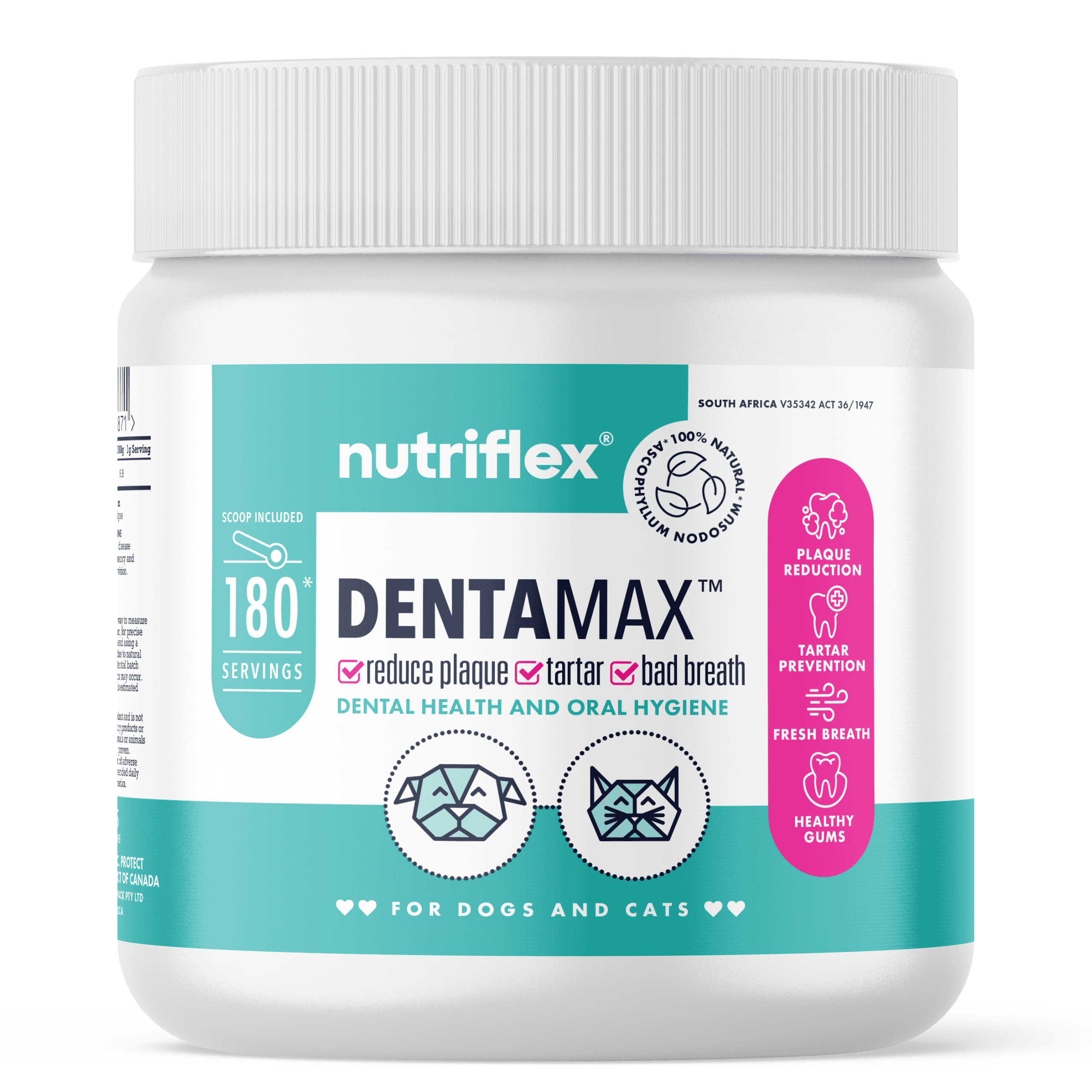
Where DentaMax™ Fits
DentaMax™ operates in the systemic layer.
- Added once daily to food
- Contains Ascophyllum nodosum, a clinically studied marine algae
- Works through saliva to influence plaque formation
Practical role:
- Helps reduce plaque formation
- Supports tartar control
- May contribute to gradual tartar reduction over time
Systemic care does not replace mechanical intervention.
It is the baseline that ensures something is happening every day.
Do Dental Powders Work for Dogs?
Yes, dental powders can help reduce plaque formation and support tartar control over time. They are most effective when used daily and combined with occasional mechanical cleaning.
Mechanical Still Matters
Mechanical care becomes targeted, not relied upon.
Use it for:
- Occasional brushing
- Dental chews
- Veterinary scaling when required
It should be considered an intervention within a broader dental care system.
Real-World Scenarios
Early Plaque (Young Dogs)
- Systemic baseline may be sufficient
- Light mechanical reinforcement can be added as needed.
Moderate Buildup
- Both systemic and mechanical approaches should be implemented concurrently.
- The frequency of mechanical intervention should be increased.
Heavy Tartar
- Professional cleaning should be performed initially.
- Subsequently, systemic care and maintenance should be implemented.
Order matters.
Cost vs Reality
Daily brushing is considered optimal in theory.
But real-world variables:
- Time
- Compliance
- Behaviour
Systemic care reduces failure probability, not just effort.
Common Misconceptions
“Chewing cleans teeth”
Chewing provides only partial cleaning and is not comprehensive.
“Supplements replace brushing”
This is incorrect; supplements reduce plaque formation but do not instantly remove existing buildup.
“Bad breath is normal”
Bad breath is a bacterial byproduct and indicates oral imbalance.
When You Need a Vet
No at-home method resolves:
- Advanced tartar
- Periodontal disease
- Loose teeth
These conditions require professional veterinary intervention.
All other measures are preventive in nature.
The Direction of Dental Care
A clear shift is occurring in dental care approaches:
From:
- Reactive cleaning
To:
- Continuous prevention
Systemic approaches are scalable because they address human inconsistency.
Final Model
- Mechanical = removal
- Systemic = prevention
Utilising both approaches is necessary to prevent oral health decline.
Best Dental Routine for Dogs
The most effective dental routine for dogs combines daily systemic support (such as a dental powder added to food) with periodic mechanical cleaning and professional care when needed.