Seaweed is one of those things owners get completely mixed messages about. On the beach, it’s a hazard your dog should stay well clear of. In the supplement aisle, it’s a superfood that’s meant to help everything from skin to teeth. So which is it?
Both, as it happens. Seaweed isn’t a single plant. It’s hundreds of species with wildly different chemistry, and whether it helps your dog or lands you at the vet comes down to 3 things: the species, the form, and the amount. Get those right and it’s good for them. Get them wrong and it isn’t.
So, is seaweed good for dogs and cats? Yes, with a few honest conditions. And the benefit with the most science behind it is probably the last one you’d guess. Here’s what holds up, and how to feed it without the risks.
The short answer: yes, but not just any seaweed
Seaweed can be good for your dog. But only the right kind, prepared the right way, in a sensible amount. That last part is where nearly all the trouble starts.
Food-grade seaweed vs the stuff on the beach
There’s a wide gap between a seaweed made for feeding and the tangle your dog finds drying on the sand. Dried wild seaweed can swell once it’s swallowed, and the American Kennel Club warns that this can cause a serious internal blockage. Beach seaweed also comes loaded with salt, grit and whatever else washed in on the tide.
So the rule writes itself. Food made for pets, never beach scavenged. If your dog does wolf down some wild seaweed on a walk, keep a close eye on them and phone your vet if anything seems off.
Seaweed and kelp aren’t the same thing
“Seaweed” is really just a catch-all for marine algae, and the species behind the word makes all the difference. Kelp is one big family within it. Ascophyllum nodosum, a brown seaweed from the cold North Atlantic, is another, and it’s the one that’s been studied most closely for pets.
When a product or a study says “seaweed”, what counts is which species it means and where it grew. A label that only says “kelp” is telling you next to nothing.
What seaweed does inside your dog
Fed properly, seaweed brings a handful of real things to the bowl. Some matter more than the marketing lets on, and one or two matter less. It’s worth knowing which is which.
Trace minerals and vitamins from a whole marine plant
Seaweed is one of the most mineral-dense foods going, pulling its profile straight from the seawater it grows in. PetMD lists iodine, iron, magnesium, calcium and potassium among them, alongside a spread of vitamins. Not many single ingredients carry that much in so little.
That concentration is the whole appeal. Because the profile is so rich, even a small daily serving hands your dog a real dose of trace minerals and vitamins, the kind that arrive wrapped up in a whole plant rather than bolted on as isolated synthetics. It’s a proper nutritional plus on top of everything else they eat. There’s one mineral where that richness counts for even more, though, and that’s iodine. We’ll come back to it, because it’s the reason the dose needs a careful hand.
The fibre that quietly feeds the gut
This is where seaweed starts to earn its keep. Brown seaweeds are full of unusual fibres and polysaccharides, complex plant sugars the body can’t fully digest. Alginates, laminarins, fucoidans: they travel down to the lower gut more or less intact and act as prebiotics, the food your dog’s good gut bacteria live on.
It’s a real benefit, and a forgiving one. Unlike the minerals, it doesn’t hinge on eating a lot to count, because it works right there in the gut instead of chasing a daily target. A little, given day after day, is plenty to keep the bacteria that ferment it happy.
That’s worth holding in mind when you look along the shelf. Plenty of dental powders now bolt on separate prebiotics, or live probiotics, and make a feature of it. There’s no harm in the idea, but it pays to know what you’re paying for. Live probiotics are a different animal to prebiotics. They have to survive being made, sitting on a shelf, and the trip through the gut before they do anything at all, and whatever benefit they carry usually belongs to one specific strain, not to the word “probiotic” on the front of the tub.
With the right whole seaweed, none of that bolting-on is needed. The prebiotic effect is already in there, coming from the single ingredient rather than from something stirred in to pad the label. One well-chosen seaweed can look after the mouth and feed the gut in the same scoop, which is a tidier way to get there than piling on extras. It’s the same thinking behind the whole product. One ingredient, pulling more than its weight, with nothing in the bowl that hasn’t earned its spot.
Antioxidants, skin and coat
Brown seaweed also carries antioxidant compounds and natural pigments that researchers have looked at for their part in protecting cells from ordinary daily wear. Plenty of owners will tell you their dog’s coat looks glossier on it.
The evidence here is broad rather than nailed down, so it’s fair to file skin and coat under “likely bonus” rather than “headline”. Seaweed is a useful whole food to have in the diet. It isn’t a fix for a skin problem, and it would be dishonest to sell it as one.
The benefit you probably weren’t expecting: dental health
Here’s the twist. The single most tested, most repeated benefit of seaweed for dogs has nothing to do with coats or digestion. It’s their teeth. And the seaweed doing the work is Ascophyllum nodosum.
It helps to understand why that lands so well. Most dogs are already carrying some dental disease early in life, and it tends to build quietly under the gumline long before the breath ever gives it away. Plaque, a film of bacteria, forms within hours. Left alone, it hardens into tartar within a day. So anything that chips away at that cycle every single day, rather than every once in a while, is worth a proper look.
The seaweed with the studies behind it: Ascophyllum nodosum
Ascophyllum nodosum has been put to the test specifically for what it does to plaque and tartar. In a randomised, placebo-controlled trial of 60 dogs in Frontiers in Veterinary Science, indexed on PubMed, taking the seaweed daily brought down plaque, tartar and the volatile sulphur compounds behind bad breath over 90 days. A 2023 review of the dog and cat evidence found the same story across the studies, and pointed out that the powder form did more than treats or dry food.
Placebo-controlled powder trials of that same active have reported average drops of roughly 32% in plaque, 35% in tartar and 67% in gingival bleeding over 30 days. It’s the same clinically studied seaweed you’ll find in products carrying Veterinary Oral Health Council (VOHC) recognition, which is a handy thing to know when you’re weighing up options. If you want to go deeper, we’ve laid out the science behind Ascophyllum nodosum on its own.
How it works, from the inside out
Most dental products do their job by contact. A brush scrubs. A chew grinds. A coating clings to the tooth for a few seconds and then it’s gone. Ascophyllum nodosum takes a different route. Your dog digests it, it’s carried into the saliva, and from there it makes the mouth a harder place for plaque to take hold and harden.
That inside-out route isn’t guesswork. A study of dog saliva, also on PubMed found the seaweed measurably shifted what was in their saliva after 30 days, which goes a long way to explaining how a powder that gets swallowed can change what happens up on the teeth. The effect showed up in people first, where a human trial saw calculus fall by 52% and concluded the alga works on oral health systemically.
It’s a different way of thinking about dental care, and once it clicks it makes sense. We’ve spelt out systemic rather than mechanical dental care and how marine algae affect plaque bacteria if you want the mechanics. The short version: because saliva does the delivering, it reaches the gumline and the tight gaps between teeth that a brush skips straight over, and it doesn’t ask your dog to sit still for anything.
Is seaweed safe for dogs and cats every day?
Yes, as long as it’s the right seaweed in the right amount. A food-grade, single-species seaweed like Ascophyllum nodosum, measured out by your pet’s weight, is fine to give daily. Daily is the whole point of it, so consistency isn’t the risk here.
Dose is. Seaweed is potent stuff, iodine especially, so more is not better. Stick to the weight-based serving and resist the urge to tip in a little extra. And if it’s your dog’s first time on a seaweed supplement, bring it in slowly and give their system a chance to settle.
What about iodine, is it safe?
Iodine is essential, no question. Dogs and cats need it for a healthy thyroid, and seaweed happens to be one of the richest natural sources of it anywhere. That very richness is why the dose matters.
Given by weight, a sensible serving adds a measured amount, not a flood. The trouble only shows up with large or unchecked amounts over time, which is exactly what weight-based dosing is there to prevent. Too much iodine can push the thyroid the wrong way, so a little restraint is simply good sense.
A few pets should clear it with a vet first: any with thyroid disease, any on thyroid medication, those pregnant or nursing, and those with kidney disease, since the kidneys have a hand in regulating iodine. For everyone else, dosed properly, the iodine in seaweed sits firmly on the plus side. There’s more on the safety of Ascophyllum nodosum if you’d like it.
Is kelp the same as Ascophyllum nodosum?
Not quite. They’re both brown seaweeds, but they part ways on species and chemistry. Kelp is a broad group of large brown seaweeds. Ascophyllum nodosum, also called knotted wrack or rockweed, is one particular North Atlantic species.
The difference earns its keep because the dental research was done on Ascophyllum nodosum, not kelp in general. And even within the species, where it’s grown, harvested and handled changes the result. So a product that names clinically studied Ascophyllum nodosum and can tell you where it came from is worth far more than one that just says “kelp” and leaves it at that.
Can cats have seaweed too?
They can, with the same rules and a bit more care. The dental evidence covers cats as well as dogs, though it’s thinner and less settled on the feline side, and that 2023 review was upfront that the data on treating existing disease in cats is still limited.
Cats are small, so precision on the dose counts for even more, and the iodine caution holds just as firmly. A single-ingredient powder measured by weight suits them nicely, since there’s no chew to turn their nose up at and no toothbrush to wrestle over. Same as with dogs: ease it in, and keep to the serving guide.
How to give your dog seaweed safely
If you want the upside without the pitfalls, a few plain rules cover it. Pick a food-grade, single-species product, ideally one that names Ascophyllum nodosum and says where it’s sourced rather than hiding behind “seaweed blend”. Measure by weight and follow the serving guide. Ease it in over the first week or two. Stir it through food, since that’s how the inside-out benefit reaches the teeth. And keep at it, because this kind of dental support builds slowly rather than arriving overnight.
The don’ts are shorter. No beach seaweed. No salted or seasoned seaweed snacks meant for people. And no doubling up in the hope of quicker results, because that’s exactly where the iodine risk sneaks in.
The bottom line
So, is seaweed good for dogs and cats? Yes, as long as you respect the same 3 things throughout: species, form and dose. Choose well, feed it food-grade and by weight, and it’s a safe, worthwhile part of a healthy diet.
The real surprise is where its strongest benefit lies. Ascophyllum nodosum has solid, repeated evidence behind it for bringing down plaque, tartar and bad breath, and it does it from the inside through saliva rather than by scrubbing. The nutrition is a welcome bonus. The teeth are the reason to take it seriously.
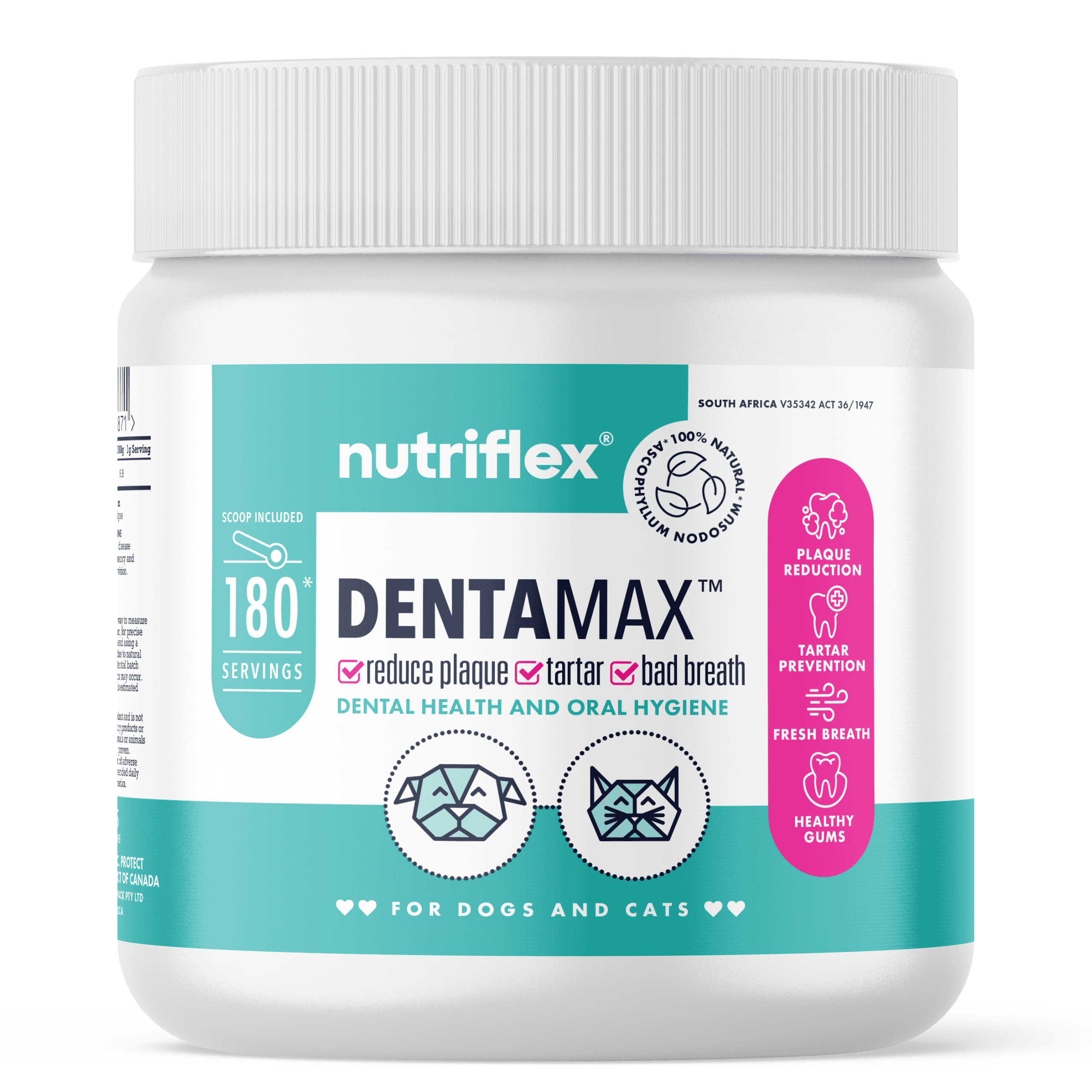
None of it happens overnight, mind. Teeth don’t work that way. But given every day, a single-ingredient Ascophyllum nodosum powder like DentaMax is an easy way to look after your dog’s teeth between vet visits. You’ll find it at nutriflex.co.za.