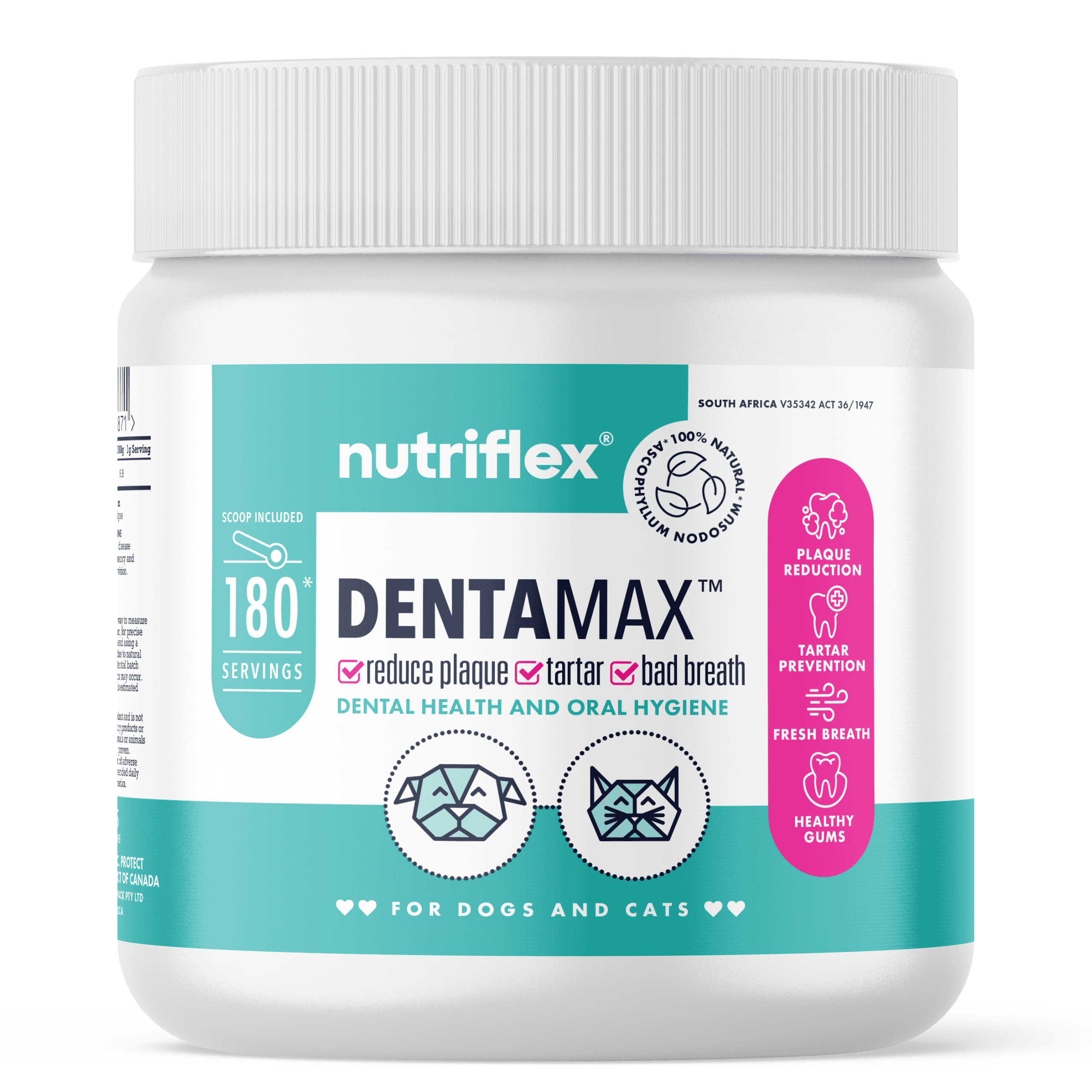
There are many pet dental powders on the market with unnecessary fillers and questionable additives. But PetWell Fresh Smile raises a more serious formulation concern. PetWell Fresh Smile is declared as 82.56% baking soda and is fed daily as a swallowed powder. This review examines the sodium load, the missing canine evidence for swallowed bicarbonate, the foaming agent and how the formula compares with DentaMax™.
The delivery matters because most baking soda evidence comes from human toothpaste use. In that context, baking soda gets brushed onto the teeth, held briefly in the mouth and spat out. Fresh Smile is different; it gets sprinkled on food and eaten. The question stops being “Does baking soda help in toothpaste?” and becomes: should a dog be swallowing this much sodium bicarbonate day after day?
That crucial question shapes the entire review. It’s why the sodium load matters. It’s why the missing evidence matters, because nobody has shown that swallowing bicarbonate of soda does anything for a dog’s teeth. And it’s why the foaming agent stands out. That kind of ingredient makes sense in something you brush on and spit out. It’s much harder to justify in a daily powder your dog swallows.
If a Fresh Smile video ad sent you here, the pitch was fair enough. Plaque builds along the gumline. Brushing really is a battle which most of us lose. A scoop on food is genuinely easy. All true. But easy isn’t the same as effective and daily isn’t the same as safe. So here’s the honest evaluation.
The evidence they cite doesn’t describe this product
To PetWell’s credit, the Fresh Smile page cites real, peer-reviewed studies. The problem is what those studies actually tested.
The main citation is a 2017 review in the Journal of the American Dental Association on baking soda toothpaste and stain removal.
But there are three major mismatches. First, wrong species. The review looks at human clinical and laboratory studies. Not dogs. Not pets. No animals at all.
Second, wrong delivery method. The studies involve toothpaste: baking soda applied to teeth, usually with brushing, then spat out. That matters. The proposed effects, abrasive stain removal and acid buffering on the tooth surface, depend on contact time and mechanical action. A dog swallowing powder with food is not the same thing. There is no brushing, no rinsing and usually only seconds of contact.
Third, wrong purpose. The review is about stain removal and whitening in human teeth. It is not about the long-term safety of dogs swallowing grams of sodium bicarbonate every day.
The same pattern shows up in the other references too. Peppermint, rosemary and green tea may have human or test-tube evidence for topical antimicrobial effects, but that is not evidence that tiny amounts, swallowed by dogs, work as meaningful dental actives. At roughly 0.02% to 0.2% inclusion, those botanicals look closer to label dressing than functional dose.
Borrowing human toothpaste studies to sell a swallowed dog powder is not necessarily dishonest. It’s just not evidence for the product in the tub.
The sodium load is the real problem
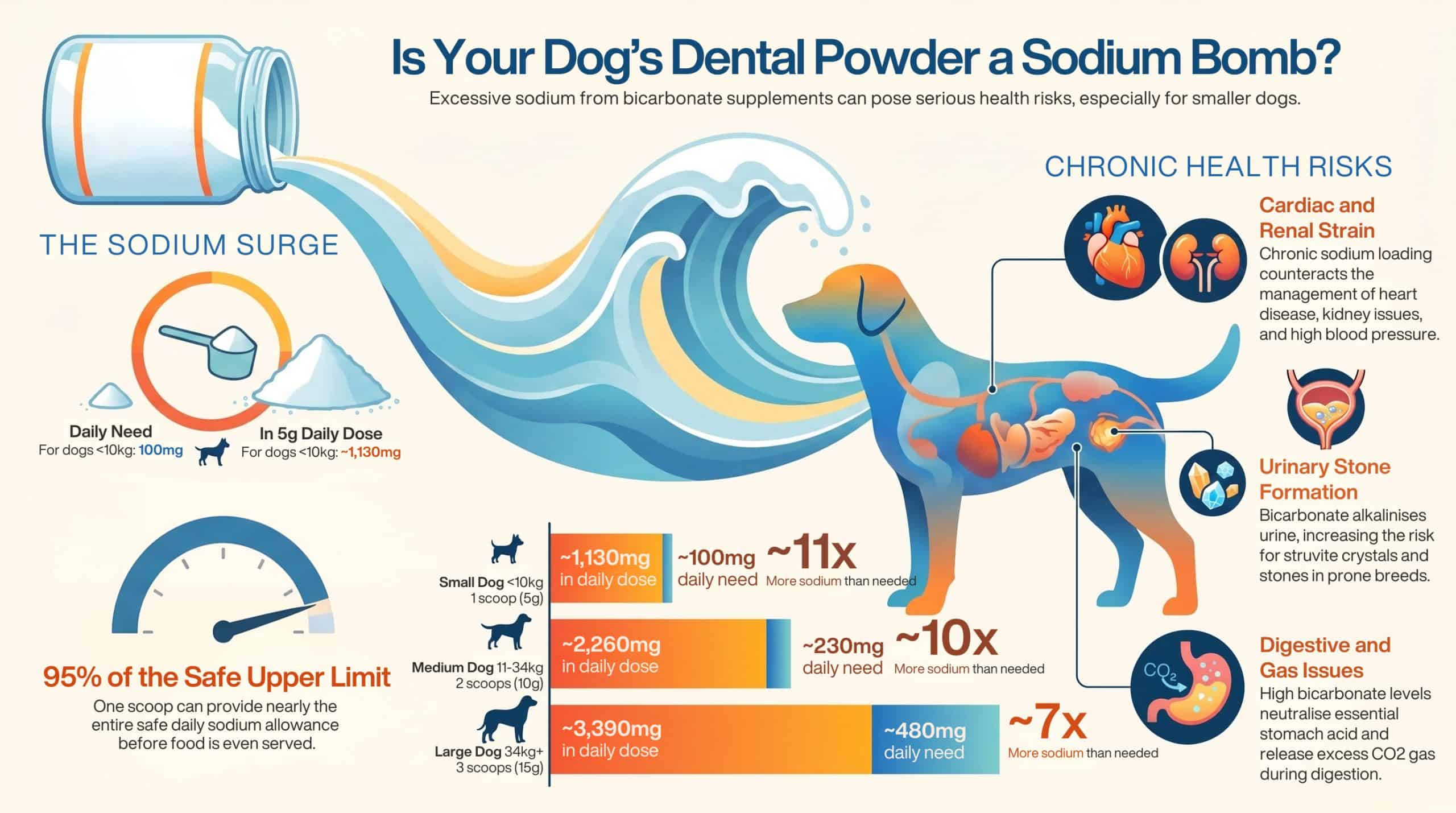
This is the part the marketing never mentions. Sodium bicarbonate is the chemical name for baking soda, also called bicarbonate of soda (formula NaHCO₃). Sodium bicarbonate is 27.4% sodium by weight. At 82.56% of the formula, every scoop delivers a serious hit of salt.
| Daily dose | Sodium swallowed | Small-dog daily need* | Multiple |
|---|---|---|---|
| 5g (small dog <10kg) | ~1,130mg | ~100mg | ~11× |
| 10g (medium 11-34kg) | ~2,260mg | ~230mg | ~10× |
| 15g (large dog 34kg+) | ~3,390mg | ~420–480mg | ~7× |
*Sodium need based on the FEDIAF Nutritional Guidelines recommended allowance for adult dogs (roughly 0.03g per kg metabolic bodyweight, or about 75mg for a small dog up to ~480mg for a large one) and consistent with the NRC (2006) canine sodium allowance. All of this is before the sodium already in your dog’s food.
Put the other way: one 5g scoop can supply up to 95% of the FEDIAF known safe upper limit for sodium (3.75g per 1,000 kcal). For a small dog one scoop can use up almost an entire day’s known safe sodium allowance before dinner is even in the bowl.
A healthy dog’s kidneys will clear the excess, so this isn’t an acute-poisoning story. Real salt toxicity sits far higher, at grams per kilogram. The concern is chronic, daily loading in the dogs least able to handle it:
- Heart, kidney or blood-pressure conditions. Sodium restriction is a cornerstone of managing all three and they’re often undiagnosed early. A daily gram-plus of sodium works directly against that. Fresh Smile’s label carries no cardiac or renal warning, which for a sodium-heavy daily product is a real omission.
- Urinary stones. Bicarbonate alkalinises urine and persistently alkaline urine is an established risk factor for struvite crystals and stones, especially in prone breeds or dogs with any UTI history.
- Digestion and gas. Bicarbonate neutralises stomach acid at every meal and releases CO₂ as it does. At 10 to 15g a day, that’s meaningful gas and a daily buffering of the acid your dog needs to digest protein.
Then there’s the dosing logic, which makes very little sense. A 4kg dog and a 10kg dog both receive the same 5g scoop, so the smallest dogs take the highest sodium load relative to their bodyweight. That matters because daily supplements are used repeatedly, often for months.
For small dogs, especially those with known heart, kidney, blood-pressure or urinary concerns, sodium intake is worth checking carefully with a vet before adding any sodium-heavy product to the bowl.
Human toothpaste logic does not belong in a dog’s bowl.
There is also a synthetic foaming surfactant in the formula: sodium lauroyl sarcosinate. It is commonly used in rinse-off products like toothpaste and shampoo. The problem is that dental powders for dogs are not rinsed out. They are swallowed.
Long-term ingestion data in dogs is essentially absent. It may be tolerated, but “no long-term safety data” is not the same as “proven safe”. Its role here is simple: it helps the product foam, because the formula appears to borrow from human toothpaste logic. The difference is that humans spit toothpaste out. Dogs don’t.
So what are you actually paying for?
A one-time pack of Fresh Smile dental powder costs R599 and gives you 75 daily scoops. That works out to a whopping R7.99 per scoop. For a large dog taking 3 scoops a day, the tub is finished in just 25 days, so you’re looking at roughly R720 a month.
Now look at what you’re actually paying for.
Fresh Smile is declared as 82.56% sodium bicarbonate, which means most of every scoop is baking soda. And because the product is sprinkled onto food, that bicarbonate is not brushed on and spat out like toothpaste. It is swallowed.
But the monthly cost is not the real concern. The point of everything above is that your dog shouldn’t be swallowing grams of bicarbonate daily. The problem was never the price. It’s the sodium load, the missing canine evidence and the toothpaste-style formula being asked to do a job it can’t possibly do once it’s been swallowed.
Does it actually work?
No canine study. No VOHC acceptance, the recognised benchmark for pet dental claims. And the big promises of “visible tartar reduction in 60 to 90 days” and reaching “areas a toothbrush can’t” are not backed by cited evidence for bicarbonate that’s sprinkled onto food and swallowed in seconds.
Peppermint and green tea can mask breath odour for a while and that’s genuine. But masking the smell doesn’t slow the plaque behind it. Plaque keeps hardening into tartar within days, minty breath or not. Fresher breath without plaque control isn’t a problem solved.
How DentaMax™ is built differently
DentaMax™ starts from the opposite question: not “what freshens breath”, but “what still works after a dog swallows it”.
One ingredient. 100% organic Ascophyllum nodosum, a North Atlantic brown seaweed. No baking soda, no fillers, no surfactants, no preservatives. It’s absorbed with food and carried into the saliva, then works systemically through saliva every time saliva coats the teeth. That reaches every surface, all day, including the back molars no chew or brush touches.
The evidence fits the format. A placebo-controlled study in dogs found daily Ascophyllum nodosum reduced plaque and calculus versus placebo, in the target species, swallowed with food, exactly how DentaMax™ is used. It’s registered under Act 36 of 1947 (V35342), made in an FSA-accredited facility and dosed by weight for both dogs and cats. You can read the ingredient science in full.
Results aren’t overnight. Dental health never is. But the claim rests on a study of this ingredient, in this species, in this format. Fresh Smile’s doesn’t.
Fresh Smile vs DentaMax™ at a glance
| PetWell Fresh Smile | DentaMax™ | |
|---|---|---|
| Main ingredient | Sodium bicarbonate (82.56%) | 100% Ascophyllum nodosum |
| Daily sodium load | ~1,130–3,390mg | Negligible |
| Evidence in dogs, swallowed | None cited | Placebo-controlled study |
| VOHC standard | No | Same active as VOHC-accepted products |
| Species | Dogs only | Dogs and cats |
| Act 36 registration | Check for a V-number | Registered in South Africa V35342 |
Which should you choose?
Ask 3 questions of any daily dental powder. Does the active ingredient work after swallowing? If it needs a brush and contact time, it belongs in toothpaste, not a food topper.
Is there evidence in dogs, for this ingredient, in this format? Toothpaste studies don’t count.
Is it safe for your dog specifically, every day, for months? Check the sodium content. Check for a V-number. And if your dog has any heart, kidney or urinary history, a gram-plus of daily salt is a conversation worth having with your vet first.
To be clear: a healthy dog isn’t going to be poisoned by Fresh Smile. But “won’t poison a healthy dog” is a low bar for something you’re meant to feed every day for life. A daily supplement should earn its place in the bowl and part of earning it is being right for the dogs most at risk, not just the ones who’ll tolerate anything. Neither powder replaces professional veterinary dental care for severe periodontal disease.
You can learn more about DentaMax™, its single-ingredient formula and where to find it at nutriflex.co.za.
Content based on publicly available information at the time of writing. Ingredient assessments reflect published literature and general veterinary guidance. Consult your vet before changing your pet’s supplement routine, particularly if your pet has a diagnosed health condition.
Content based on publicly available information at the time of writing. Ingredient assessments reflect published literature and general veterinary guidance. Consult your vet before changing your pet’s supplement routine, particularly if your pet has a diagnosed health condition.