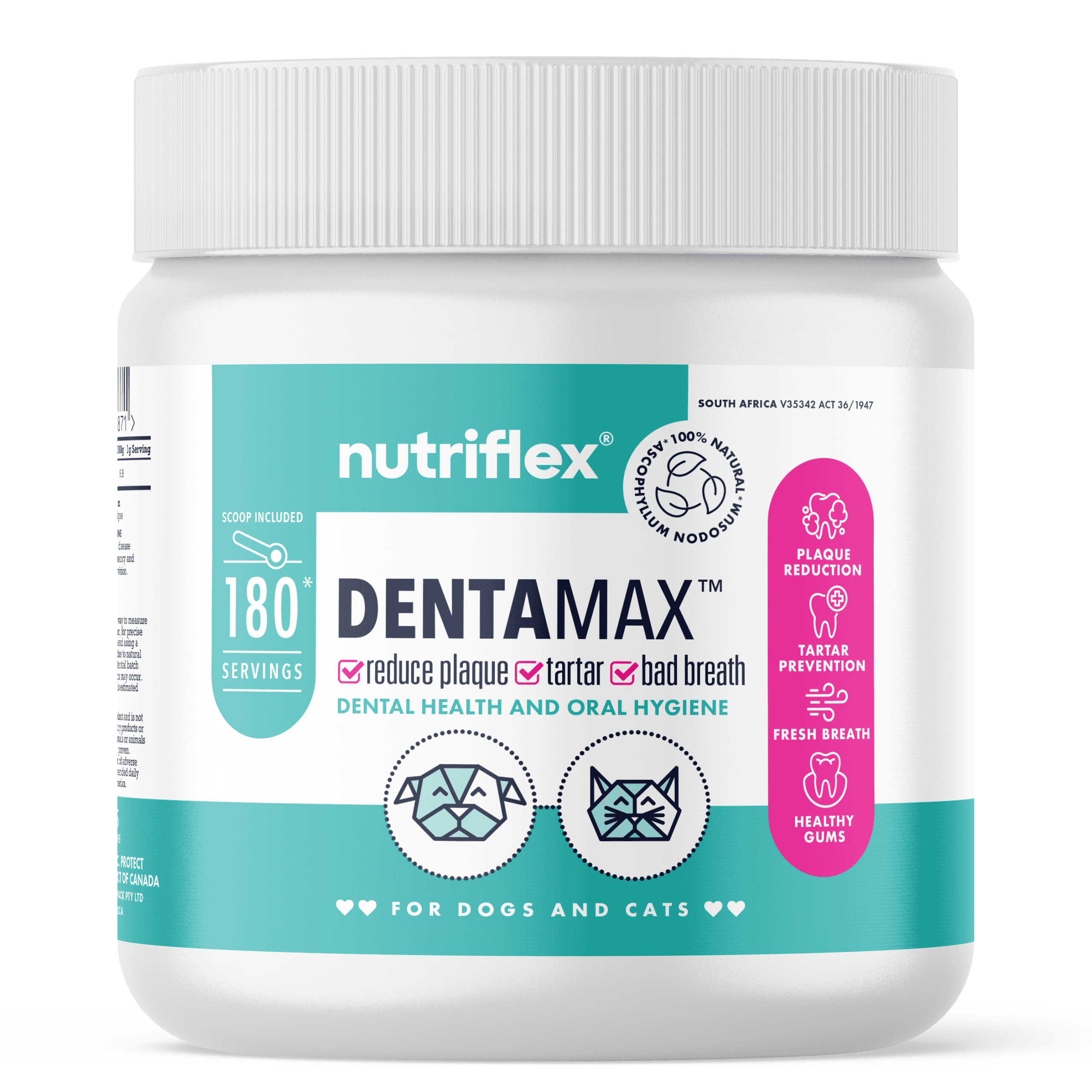
Dental powders are often grouped together as if they function the same way.
They don’t.
To understand how DentaMax™ works, you first need to understand how systemic dental powders work for plaque and tartar control and how that differs from mechanical plaque control.
Most dental products rely on surface contact.
Dental powder works differently.
A systemic approach to dental care influences the oral environment through saliva, helping disrupt plaque formation before it hardens into tartar. Regular dental care is essential for maintaining a dog’s health, as plaque buildup on dog teeth can lead to serious dental issues.
This is not about scraping teeth.
It’s about influencing the oral environment from within.
When used consistently, using DentaMax™ dental powder effectively supports ongoing plaque control, fresher breath and improved gum health.
Mechanical vs Systemic Plaque Control
Most traditional dental products rely on mechanical action.
Examples include:
- Brushing
- Dental chews
- Coated kibble
- Water additives
These approaches depend on direct contact with the tooth surface.
In practice, that contact is inconsistent.
Plaque continues to form:
- along the gumline
- between teeth
- in areas where brushing or chewing does not reach
This is why results vary.
Systemic dental powders do not rely on contact.
They work continuously through saliva.
How Systemic Dental Powders Work
Systemic dental powders are added to food and consumed daily.
After digestion, specific compounds are absorbed and later released into saliva.
Saliva is constantly present in the mouth.
It coats teeth, gums and hard-to-reach areas throughout the day.
By altering the composition of saliva, certain ingredients help make the oral environment less favourable for plaque accumulation.
This is the core principle behind how systemic dental powders work.
It is not mechanical scraping.
It is continuous biological plaque control.
The Role of Ascophyllum Nodosum
The active ingredient in DentaMax™ dog & cat dental powder is Ascophyllum nodosum for dogs, a North Atlantic brown marine alga that has been studied for its effects on plaque and tartar.
In controlled studies on this specific ingredient, daily intake demonstrated:
- Up to 32% reduction in plaque
- Up to 35% reduction in tartar
- Up to 67% reduction in gingival bleeding
These outcomes are linked to the ingredient itself, not generic blends.
Ascophyllum nodosum has also been used in formulations recognised by the Veterinary Oral Health Council (VOHC), indicating alignment with established plaque-reduction standards.
Understanding how Ascophyllum nodosum supports plaque and tartar control is central to evaluating systemic dental powders.
What Makes This Different From Chews or Charcoal?
Many dental products rely on surface-level effects or cosmetic masking.
For example:
- Chews attempt to reduce plaque through abrasion.
- Activated charcoal in dog dental powders may bind compounds in the digestive tract, but it does not provide clinically validated systemic plaque control.
- Sodium hexametaphosphate (SHMP) in dog dental powders depends on sustained tooth contact and is typically applied as a coating.
These approaches are limited by where they reach.
Systemic powders operate continuously, regardless of chewing behaviour or brushing consistency.
For a broader overview of available options, see our guide to dog & cat dental powder in South Africa.