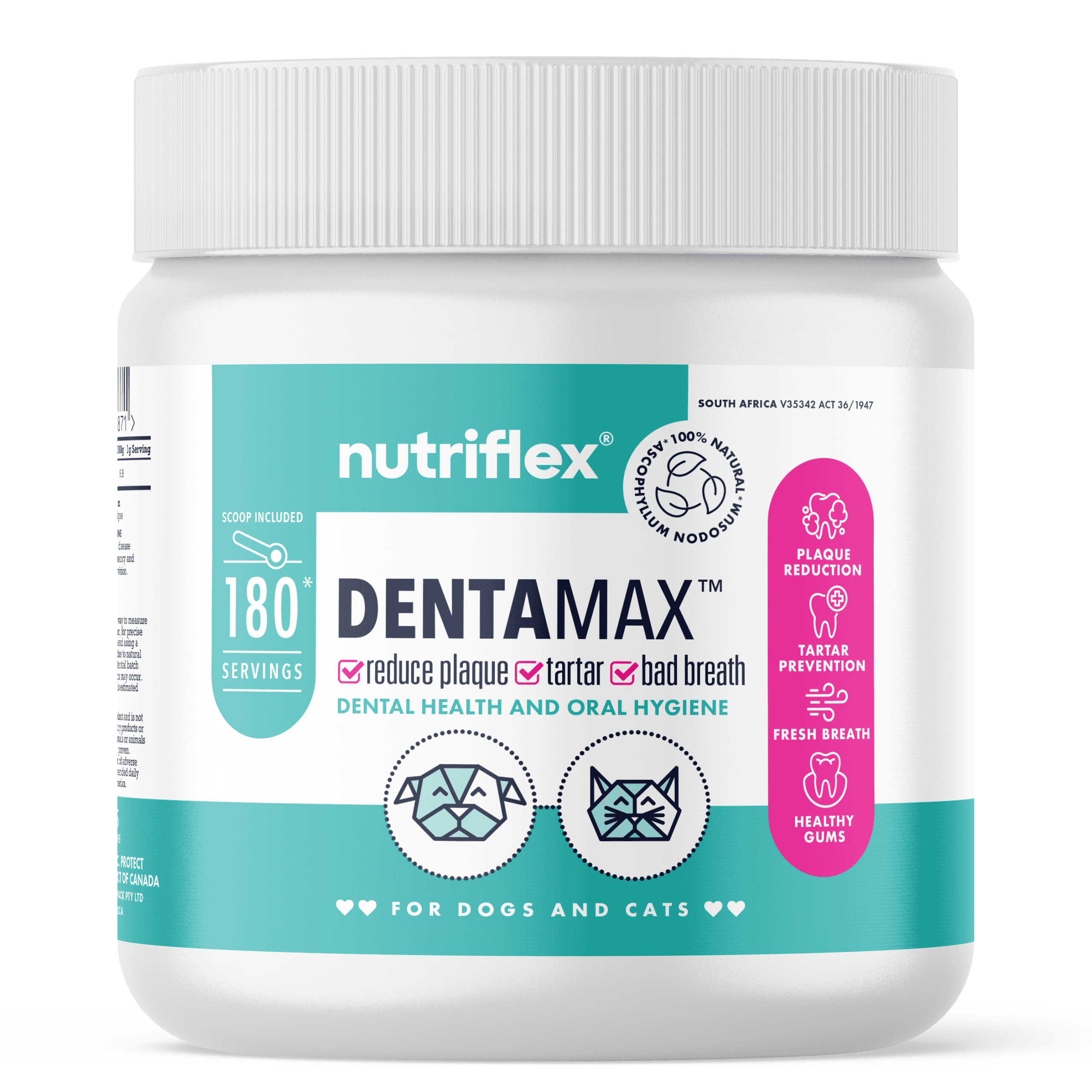
Quick answer: Activated charcoal is not an effective daily ingredient for plaque, tartar or bad-breath control in dogs. It binds substances in the gut, while most persistent dog breath starts in the mouth, where plaque bacteria release odour-causing gases along the gumline. Charcoal has no clinical evidence for reducing plaque or tartar and daily use can bind nutrients, minerals and medications your dog needs.
Activated charcoal is turning up in more pet dental powders every year. It’s usually sold as a “natural detoxifier” or a tooth-whitening agent. Both claims sound reasonable. Neither holds up once you look at how charcoal actually behaves inside a dog’s body. Before you assume it helps, ask what charcoal actually does and whether that matches the job of daily plaque control. It doesn’t. Here’s why.
What does activated charcoal actually do in a dog’s body?
Activated charcoal is a highly porous form of carbon. Its one real job is adsorption, which means binding substances to its surface as it moves through the digestive tract.
In veterinary medicine, it’s a well-established tool for acute toxin exposure. Vets use it to bind certain ingested compounds and reduce how much the gut absorbs. That’s a genuine, useful function. It’s why charcoal sits in emergency kits, not daily feeding routines.
But here’s the part the marketing skips. Activated charcoal isn’t absorbed into the bloodstream. It doesn’t circulate through the body. It doesn’t change the composition of saliva. Its entire action stays in the gut and then it leaves. That single fact decides everything about whether it can help your dog’s teeth.
Why gut binding can’t control plaque on teeth
Plaque forms on the tooth surface. It is a bacterial biofilm and after eating, oral bacteria begin using food particles and saliva proteins to rebuild it. For a powder mixed into food to help control plaque, the active compounds need to survive digestion, be absorbed and reach the mouth again through saliva.
A systemic dental powder works by being digested, having its active compounds absorbed into the bloodstream, then carried into saliva. From there it can influence the oral environment every time saliva coats the teeth. If you want the full breakdown, we’ve explained how systemic dental powders work in a separate guide.
Activated charcoal doesn’t follow that path. It isn’t absorbed, so it never reaches saliva in an active form. It can’t influence how bacterial biofilm develops on the teeth, because it never gets there. There’s no established clinical evidence that charcoal reduces plaque or tartar through a systemic route. The mechanism simply doesn’t exist.
The binding problem: what daily charcoal may cost your dog
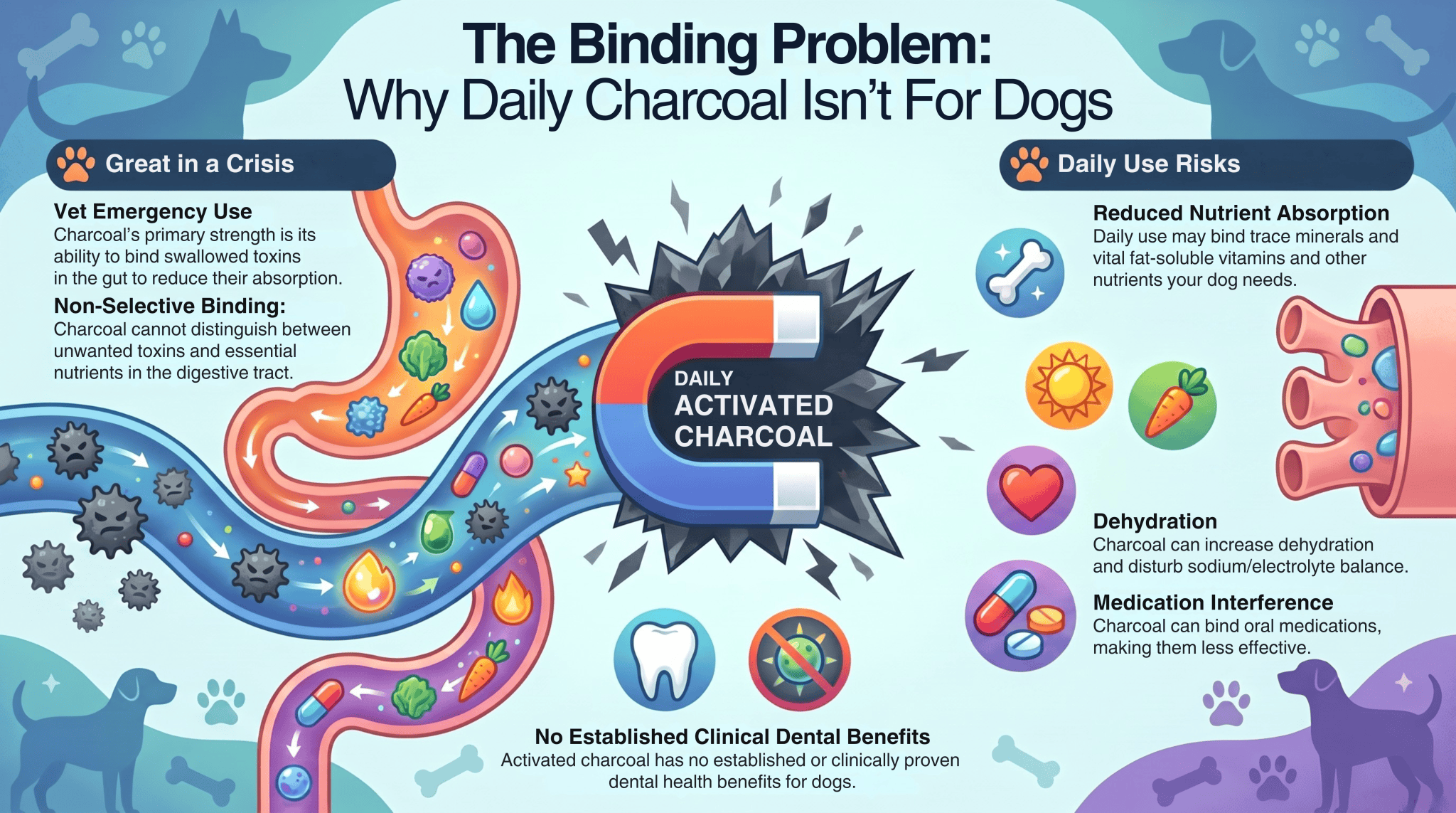
Charcoal binds compounds. That’s its strength in an emergency. In a daily supplement, that same property becomes a drawback.
A strong adsorbent doesn’t choose what it binds. Alongside anything unwanted, activated charcoal may also bind nutrients, trace minerals, fat-soluble vitamins and any medication your dog is taking. Occasional use under guidance is one thing. Feeding a strong binding agent every day, for months, in a product meant for long-term use, raises a fair question.
Daily plaque support shouldn’t lean on an ingredient designed to reduce absorption. If an ingredient earns a place in the bowl every single day, its benefit should be clear and its trade-offs should be small. Charcoal fails that test for daily dental use.
Does activated charcoal whiten dog teeth?
Charcoal may produce a slight surface effect on how teeth look. That effect is minimal, temporary and purely cosmetic. It doesn’t touch the biological process that drives plaque and tartar.
This is the distinction that gets lost. A tooth can look marginally cleaner on the surface while the biofilm underneath keeps forming exactly as before. Whitening the visible surface and controlling plaque are two different jobs. Charcoal, at best, gestures at the first and does nothing for the second.
Any real improvement in breath or visible cleanliness that comes from actual plaque reduction is already achieved through clinically studied Ascophyllum nodosum, without adding a strong adsorbent to the digestive tract. You don’t need the charcoal to get the cosmetic result.
But doesn’t charcoal bind the compounds that cause bad breath?
It sounds logical and it’s the claim some charcoal-infused dental products lead with. It immediately falls apart on one detail: where the smell is actually made.
Dog bad breath is made in the mouth, not the gut. Anaerobic bacteria along the gumline break down plaque and release volatile sulphur compounds, the gases behind that distinctive odour. It starts at the tooth surface, right where the plaque sits.
Charcoal only binds what it physically touches. In a swallowed powder, any contact with the mouth lasts seconds before the charcoal is carried down into the gut. It doesn’t stay at the gumline, work into the plaque, or reduce the bacteria making the smell.
Yes, digestive imbalance, reflux, kidney disease, liver disease, diabetes and other health problems can also affect breath. If bad breath is severe, sudden, sweet, chemical, rotten, or comes with vomiting, diarrhoea, weight loss, thirst, appetite changes or lethargy, that needs a vet.
But for ordinary plaque-related dog breath, charcoal is working in the wrong place. Even if it binds a few compounds on the way down, it leaves the source of untouched. The plaque stays on the teeth, the bacteria stay active and the odour keeps being produced.
The dependable way to tackle the smell is to control the plaque feeding those bacteria. That’s an oral job, handled at the gumline, which is exactly why plaque causes bad breath in the first place.
Is activated charcoal safe for dogs?
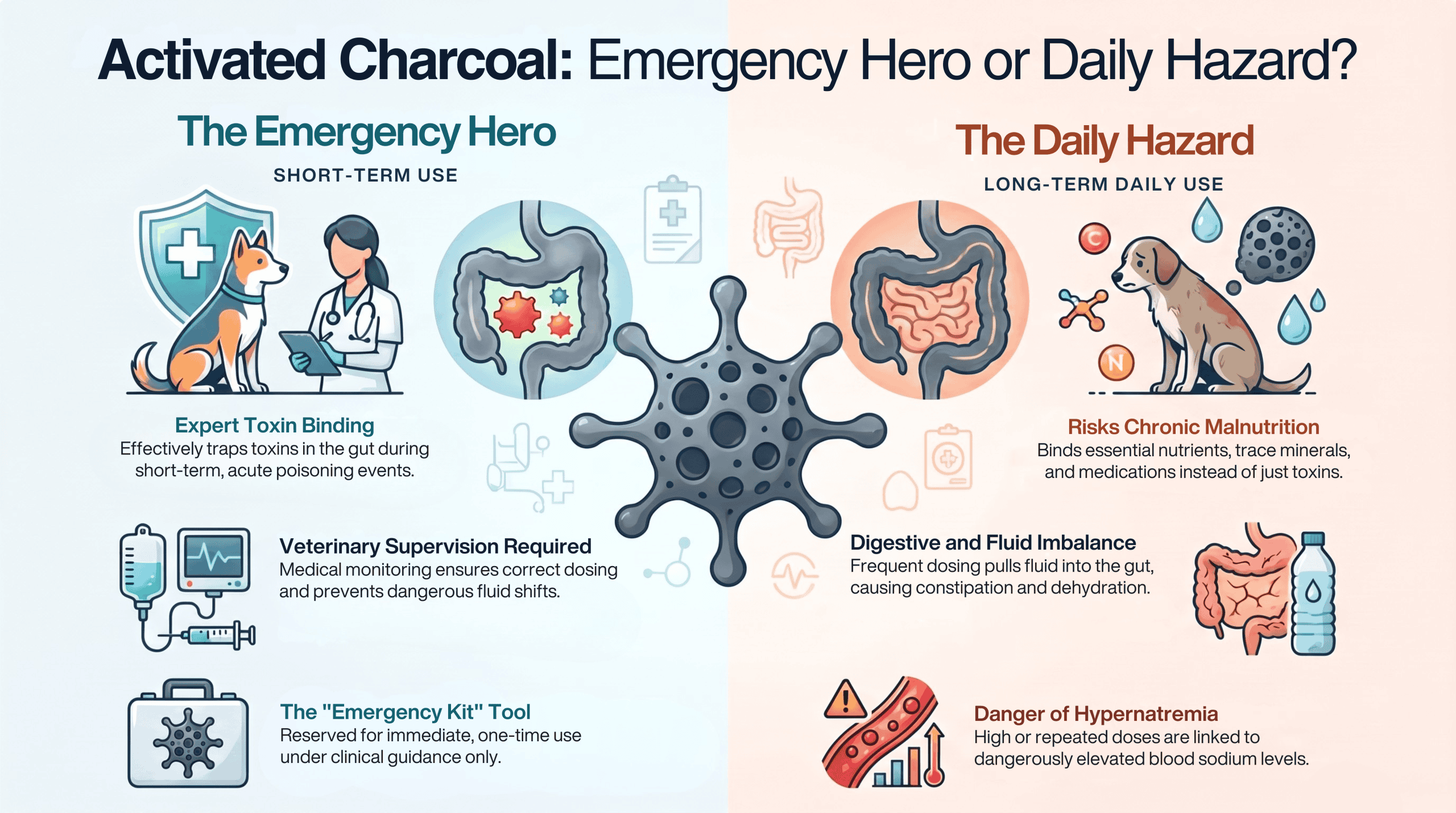
Activated charcoal is not inherently unsafe. Used short-term, under veterinary supervision, for toxin binding, it has a legitimate and valuable role.
The concern isn’t safety in the dramatic sense. It’s suitability for daily, long-term use. Its strong adsorptive properties mean it can bind the good along with the bad, including nutrients, trace minerals and medications. For a supplement your dog takes every day as a preventative, that warrants real caution to avoid malnutrition over time.
So the honest answer is: charcoal isn’t unsafe, it just belongs in the emergency kit, not the daily scoop.
What repeated dosing can do beyond nutrient binding
Charcoal’s binding action isn’t limited to what’s sitting in the gut. With repeated or high-dose use, that same pulling action can draw fluid into the intestinal tract, which is why constipation and dehydration are known concerns with frequent dosing. In more pronounced cases, that fluid shift has been linked to elevated blood sodium, a condition called hypernatremia, which needs prompt veterinary attention.
It’s one more reason vets reserve charcoal for a single, supervised dose rather than a routine ingredient. The dosing and monitoring that make it safe in an emergency are exactly what’s missing once the same compound is measured into a scoop and fed every day.
The dilution problem: charcoal takes up space in the scoop
There’s a practical issue that gets overlooked. When charcoal is added to a seaweed-based dental powder, it takes up part of the formula. If the scoop size stays the same, there’s less Ascophyllum nodosum per serving.
That means the clinically studied active ingredient gets diluted to make room for an ingredient with no proven plaque benefit. You’re paying for volume, not for more of the thing that actually works.
The trade-off becomes clear when you lay it out. On one side, a negligible cosmetic surface effect. On the other, a diluted active ingredient plus a daily binding agent in the gut that may interfere with nutrient absorption. For anyone comparing dental supplements, that’s the kind of detail worth understanding. Some ingredients are included because they look good on a label. Others are chosen because they’ve been studied for their effect on plaque and oral biofilm. If you want to see how different compounds compare, our guide to natural plaque control ingredients breaks down what the evidence supports and our full ingredient analysis library goes deeper on each one.
Why DentaMax™ leaves activated charcoal out
DentaMax™ is built around a single clinically studied systemic ingredient: Ascophyllum nodosum. The goal is straightforward. Support biological plaque modulation, help manage tartar and support the daily oral environment through saliva.
An ingredient whose main mechanism is gut adsorption doesn’t advance that goal. It would introduce a mechanical conflict, add potential nutrient binding and deliver no proven systemic plaque advantage. So it’s left out on purpose.
This isn’t caution for its own sake. It’s the same standard applied to every ingredient decision. We don’t add compounds because they’re trending on product labels. We add them when they make sense for the format and the job. You can see the full formulation on the DentaMax™ Dog & Cat Dental Powder page. One active ingredient, chosen deliberately, with documented plaque-support outcomes.
When is activated charcoal appropriate for dogs?
Activated charcoal has real, valuable uses. The clearest is acute toxin management under veterinary guidance, where its binding action is exactly what’s needed.
In practice, that usually means one dose, given under veterinary supervision, after a dog has gotten into something like a chocolate stash or a dropped strip of medication, before much of it has reached the bloodstream. Timing is the whole point: charcoal only helps in that narrow window before a toxin is absorbed, not as something fed alongside every meal.
The point isn’t that charcoal is bad. It’s that charcoal is the wrong fit for long-term plaque prevention. A tool that binds substances in the gut is a poor fit for a job that needs an ingredient to reach the teeth through saliva.
Charcoal can help in a crisis. That doesn’t make it safe or useful every day.
If your dog swallows something toxic, activated charcoal may be part of the veterinary response. But for daily dental care, it is the wrong tool: no proven plaque benefit, no gumline action and a real risk of binding nutrients, minerals and medications your dog needs.
What should you look for in a dog dental powder instead?
Look for a single, clearly named active ingredient with published evidence behind it, not a long list of extras that pad the label. A daily dental powder should tell you exactly what’s in it and why each ingredient is there.
A swallowed dental powder has one job: reach the mouth after it has been eaten. If it cannot do that, it is just passing through.
That is the problem with charcoal. A powder mixed into food is swallowed quickly, so it cannot depend on long contact with the teeth. To support plaque control from the inside, an ingredient must be absorbed and carried back into the mouth through saliva. Charcoal is not absorbed. It stays in the gut, binds what it touches there and never reaches the plaque where the dental problem starts.
The bottom line
Activated charcoal binds substances in the digestive tract. There’s no clinical evidence that it reduces plaque, tartar or bad breath and in a daily supplement its binding action can work against nutrient absorption.
Daily plaque control needs an ingredient that influences the oral environment biologically. Charcoal doesn’t do that. That’s why DentaMax™ doesn’t include it.
If you’re weighing up options available locally, our guide to dog and cat dental powder in South Africa walks through what actually supports plaque, tartar and breath and what is just marketing dressed up as dental care. When you’re ready to see the formulation itself, you’ll find it at nutriflex.co.za.
Is activated charcoal bad for dogs when given daily?
Charcoal is not a canine dental ingredient. It’s an emergency binder. A single dose is not the concern. Daily use is. Activated charcoal has a valid role in veterinary emergencies, usually under professional guidance. But once swallowed, it works in the gut, not in the mouth so it is unlikely to address plaque or bad breath in any meaningful way.
The issue is its binding action. Used repeatedly, charcoal may also interfere with nutrients, trace minerals, or medication your dog actually needs. So the problem is not that “charcoal is toxic”. The problem is that it’s being marketed for dental health without clinically validated dental benefits.
What are the side effects of activated charcoal for dogs?
With repeated or high-dose use, the most commonly raised concerns are nutrient and medication binding, along with fluid being drawn into the intestinal tract, which can lead to constipation and dehydration. In more pronounced cases, that fluid shift has been linked to elevated blood sodium, a condition called hypernatremia, which needs prompt veterinary attention. These effects are tied to repeated or high-dose use, not the single supervised dose a vet gives in an emergency.
Is human activated charcoal safe for dogs?
The bigger risk usually isn’t the charcoal itself, it’s what it’s packaged with. Human charcoal capsules, powders and drinks are often formulated with flavouring or sweeteners dosed for a person’s size, not a dog’s, and some common sweeteners are toxic to dogs in small amounts. Anything made and dosed for people should go through a vet first, not straight into your dog’s bowl.
What’s a substitute for activated charcoal in dog dental care?
Look for a dental powder built around an ingredient that’s actually absorbed and carried into saliva, since that’s the only path that reaches the plaque forming at the gumline. That’s the standard DentaMax™ is built to, using a single studied ingredient, Ascophyllum nodosum, instead of added charcoal. You can see the full formulation at nutriflex.co.za.