Fish Breath and What to Do About It
Bad breath in cats is one of those things you tend to normalise. It gets written off as “fish breath” or just the way cats smell. But persistent bad breath, the kind that lingers and gets worse over time, is almost always a sign that something’s happening in your cat’s mouth that deserves attention.
The clinical term is halitosis. In cats, it’s most commonly caused by dental disease. That means plaque, tartar, bacterial activity and gum inflammation, a chain of events that often starts quietly and progresses before you notice any obvious signs. By the time the smell becomes hard to ignore, the process is usually already well underway.
This article explains what causes bad breath in cats, how the plaque-to-tartar progression works, when other health conditions may be involved, and what you can do to support your cat’s oral health between vet visits.
The Most Common Cause: Plaque and Dental Disease
If your cat has persistent bad breath, the most likely cause is dental disease. Specifically, it’s the buildup of plaque and the bacterial activity it triggers. Understanding how this develops makes it easier to act on.
What Plaque Is and How Quickly It Forms
Plaque is a soft, sticky film made up of bacteria, saliva and food particles. It forms on the surface of your cat’s teeth continuously, within hours of a meal. In small amounts, some of it’s naturally displaced when your cat eats or grooms. But without regular removal, it accumulates along the gumline and between teeth.
Bacterial activity within plaque is what produces odour. Bacteria feed on food debris and dead tissue, releasing foul-smelling sulphur compounds in the process. These compounds are a primary source of the distinctive smell associated with feline halitosis. The worse the plaque buildup, the worse the smell.
How Plaque Becomes Tartar and Why That Matters
The bigger problem is what happens when plaque isn’t removed. Within 36 to 48 hours, plaque starts to mineralise. It absorbs minerals from the saliva and hardens into tartar (also called calculus). Tartar can’t be brushed away at home. It bonds tightly to the tooth surface and requires professional scaling under anaesthesia to remove.
Understanding how quickly plaque hardens into tartar helps explain why early intervention matters. Tartar isn’t just a cosmetic problem. Its rough surface provides bacteria with more area to colonise, which accelerates the progression of dental disease.
Gingivitis, Periodontitis and the Smell They Produce
Once tartar builds along the gumline, the gum tissue becomes irritated and inflamed. This is gingivitis. The gums redden, swell and may bleed. Bacteria begin to migrate below the gumline, where the immune system responds with further inflammation.
If gingivitis isn’t addressed through professional cleaning and daily home care, it can progress to periodontitis. At that stage, dental disease in dogs and cats follows the same destructive pattern: the tissue supporting the teeth breaks down, bone loss can occur and teeth may eventually loosen. The bacterial activity at this level produces a stronger, more persistent smell than early-stage plaque alone. Some cats with advanced periodontal disease also develop stomatitis, a painful inflammatory condition affecting the soft tissue of the mouth.
Why Does My Cat’s Breath Smell So Bad?
The smell comes from bacteria. More specifically, it comes from the waste products bacteria produce as they break down food particles and tissue within plaque and tartar deposits.
The primary offenders are volatile sulphur compounds, the same compounds responsible for bad breath in humans with gum disease. They’re produced when anaerobic bacteria (bacteria that thrive in low-oxygen environments, like pockets beneath the gumline) metabolise proteins. The deeper and more established the infection, the stronger and more unpleasant the smell.
A mildly unpleasant smell after a fish-based meal is normal. A persistent smell that doesn’t clear or one that gets noticeably worse over time points to an active bacterial process that’s worth investigating with a vet.
Other Causes of Bad Breath in Cats Worth Knowing About
Dental disease accounts for the majority of bad breath cases in cats, but it’s not the only cause. In some situations, the smell can point to something happening elsewhere in the body.
Kidney Disease and the Ammonia Smell
When the kidneys aren’t filtering waste efficiently, certain compounds build up in the bloodstream. One result is that your cat’s breath may take on an ammonia-like or urine-like smell. Cornell University’s feline health centre notes that this odour profile, particularly when combined with increased thirst, urination or weight loss, warrants a veterinary check.
Diabetes and Sweet or Fruity Breath
A sweet or slightly fruity smell can be a sign of diabetes in cats. It’s caused by ketones, compounds produced when the body starts breaking down fat for energy instead of glucose. If your cat’s breath has an unusual sweetness along with other signs like increased thirst or changes in appetite, take it to your vet.
Diet, Food Particles and Oral Infections
Wet food, particularly fish-based varieties, can leave a strong lingering smell. Food particles trapped between teeth or along the gumline can also decompose, contributing to odour. In some cases, a broken tooth, an ulcer or an oral infection is the source. The smell tends to be localised and particularly foul, sometimes accompanied by reluctance to eat or pawing at the mouth.
These causes are worth knowing about, but they don’t change the underlying advice. Persistent, worsening bad breath should be examined by a vet to rule out disease.
Is Cat Bad Breath a Sign of Something Serious?
Often, yes, when it’s persistent.
The key distinction is between mild, transient odour (usually food-related and short-lived) and ongoing halitosis that doesn’t clear. The latter almost always indicates active bacterial disease in the mouth, even if your cat seems otherwise fine and is eating normally. Cats are good at masking discomfort, and dental pain is commonly underestimated as a result.
If your cat’s breath has been consistently unpleasant for more than a week or 2, or if you notice red or swollen gums, difficulty eating, drooling, visible tartar on the teeth or changes in behaviour around food, a veterinary dental examination is the right next step. A vet can assess the degree of plaque and tartar buildup, screen for systemic conditions and recommend whether a professional cleaning is needed.
Bad breath isn’t an emergency in itself. But it’s a reliable signal that the mouth needs attention.
What You Can Do to Support Your Cat’s Oral Health Daily
Veterinary dental checks and professional cleanings address existing disease. What you do at home between those appointments determines how quickly the problem comes back.
Brushing: Ideal but Rarely Maintained
Daily tooth brushing remains the most effective form of home dental care for cats. It physically disrupts the plaque biofilm before it can mineralise. Cornell’s feline dental health guidance recommends brushing as the gold standard, but notes that most cats require gradual introduction and patient training, and that cats with active gingivitis may find brushing painful.
The practical reality is that most cat owners don’t manage to brush their cat’s teeth daily. Cats resist. Routines slip. That’s not a failing. It’s the honest picture of what daily brushing with a cat looks like in most households.
Daily Dental Supplements: How Systemic Support Works
Some dental support works not through surface contact, but systemically through the saliva. When a supplement is absorbed after eating, its active compounds are carried into the bloodstream and eventually secreted into the oral environment via the saliva. Every time saliva coats the teeth, those compounds work against bacterial adhesion.
That’s the basis of how a dental powder works through saliva to support plaque control without requiring your cat to cooperate with a toothbrush. It’s not a replacement for professional care, but it’s a practical daily tool that fits into a routine you can actually maintain.
If you want to understand your options more broadly, this guide to natural ways to manage cat plaque covers the main approaches and the evidence for each.
What to Look for in a Cat Dental Supplement
Not all dental supplements are formulated the same way. Before choosing one, it’s worth asking 3 questions: Has the active ingredient been clinically studied in cats specifically? Is the dosing appropriate for the format (a powder behaves differently in the body than a chew or coated kibble)? Does the ingredient list include anything that doesn’t need to be there?
A daily supplement earns its place by having a clear function, a studied ingredient and a format that actually delivers it.
Does a Dental Powder Actually Help Cat Bad Breath?
The evidence for the use of seaweed-based dental powders in cats is compelling. Ascophyllum nodosum, a North Atlantic brown seaweed, has been studied for its effect on oral health in both dogs and cats. A review published on PubMed (PMID 37727971) found that oral supplementation with Ascophyllum nodosum reduced both plaque and calculus accumulation in cats. It also found that the powder format produced the strongest results compared to dental chews or supplemented dry food.
The mechanism is systemic. The seaweed, when ingested with food, is absorbed into the bloodstream and carried into the saliva. It doesn’t rely on direct tooth contact, which matters for a supplement that’s swallowed quickly rather than chewed over a sustained period. That’s also why the format makes sense for cats. No brushing, no fighting, just add to food once a day.
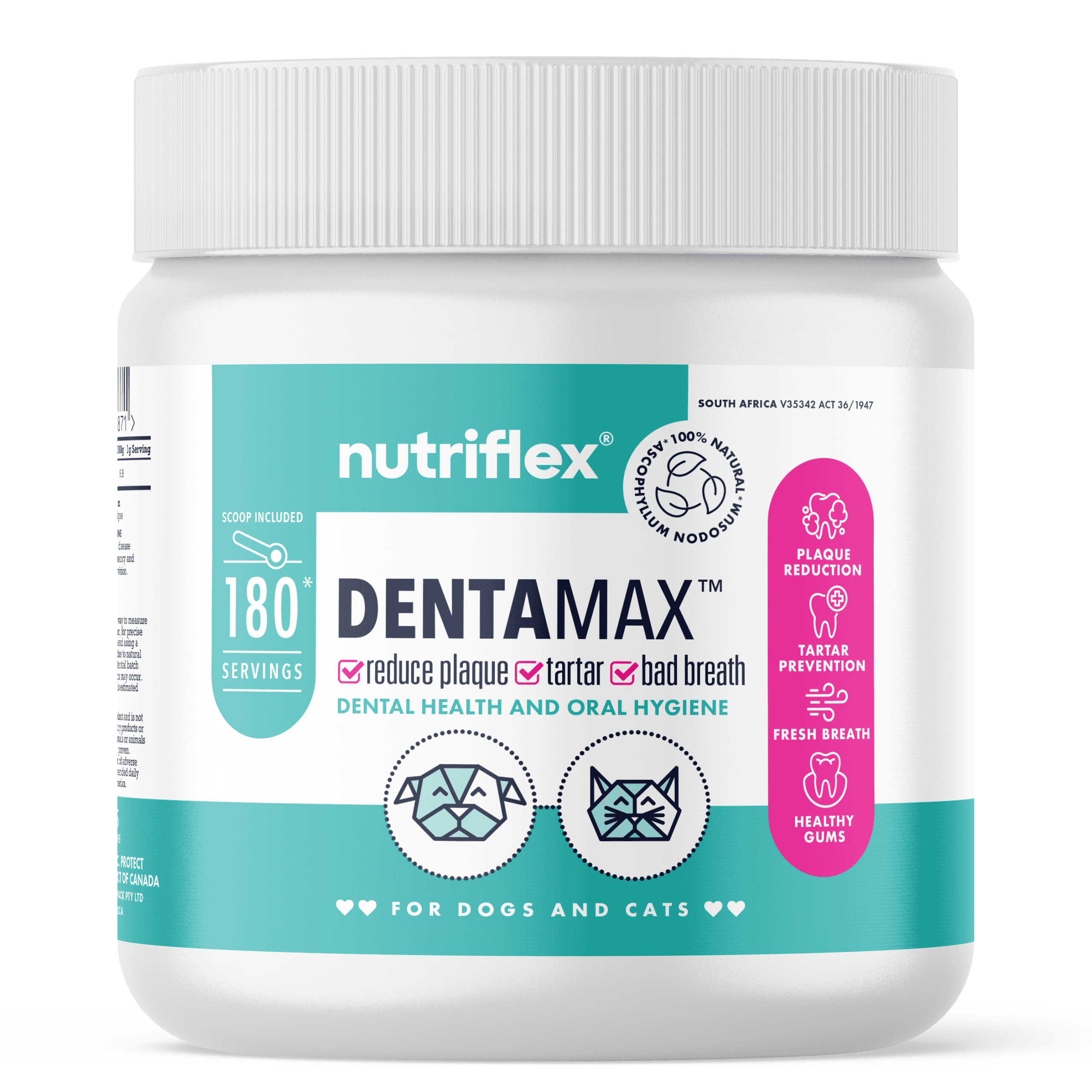
DentaMax™ is a single-ingredient dental powder made from 100% organic Ascophyllum nodosum. No fillers, no proprietary blends, no ingredients added for appearance. It’s registered under V35342 (Act 36 of 1947), produced in an FSA-accredited facility and certified to human-grade standards. For cat owners looking for a daily baseline they can actually maintain, it’s worth considering. Full product details and stockists are at nutriflex.co.za.
If you have questions about how it works or whether it’s right for your cat, the DentaMax FAQ covers the most common queries on dosing, safety and what to expect with consistent use.
The Bottom Line
Bad breath in cats starts with plaque. Plaque is a bacterial film that forms continuously on the teeth, hardens into tartar within 36 to 48 hours if not removed and creates the conditions for gum inflammation, infection and the sulphur compounds that produce the smell.
Most cats develop some degree of dental disease in their lifetime. The question is how far it progresses before it’s caught, and how much daily support the teeth and gums receive between vet visits.
Brushing is worth attempting. A daily dental supplement with a clinically studied ingredient is a practical addition for cat owners who can’t maintain brushing. Professional veterinary dental care remains essential for assessing and treating existing disease.
Not overnight. Dental health doesn’t work that way. But with consistent daily care, you can support cleaner teeth, fresher breath and a healthier mouth over time.