The Persistent Myth That Kibble Cleans Dog Teeth
Many dog owners believe that feeding dry dog food helps keep their dog’s teeth clean.
The reasoning seems simple. Kibble is crunchy, so chewing it should scrape plaque off the teeth. This idea has been repeated for decades in pet food marketing and is still widely believed today.
However, when the biology of plaque formation and the way dogs actually eat are examined, the claim quickly falls apart.
Understanding how dental disease develops helps explain why kibble rarely provides meaningful protection against plaque and tartar.
Why Dental Health Matters in Dogs
Dental disease is one of the most common health problems affecting dogs.
Veterinary research consistently shows that a large percentage of dogs develop periodontal disease by the age of three.
The condition begins with plaque accumulation and gradually progresses over time. In many cases the early stages go unnoticed by owners.
As dental disease advances, it can lead to:
-
persistent bad breath
-
inflamed or bleeding gums
-
loose teeth
-
oral pain
-
bacterial infection below the gum line
Because dental disease develops gradually, prevention is far easier than treatment.
What Plaque Actually Is
Plaque is not simply leftover food particles stuck to teeth.
It is a living bacterial biofilm that forms when oral bacteria attach to the tooth surface and begin multiplying.
Within hours after eating, bacteria start building a sticky film on the enamel. This biofilm becomes increasingly structured and difficult to remove over time.
If plaque is not disrupted regularly, it continues to grow and spread along the gum line.
How Plaque Turns Into Tartar
When plaque remains on teeth, minerals in saliva begin binding to the bacterial film.
This process causes plaque to harden into tartar, also known as dental calculus.
Once tartar forms, it becomes extremely difficult to remove without professional dental cleaning.
Tartar buildup irritates the gums and creates an environment where harmful bacteria thrive below the gum line. This is where periodontal disease begins.
Why Plaque Must Be Physically Disrupted
Plaque is highly organised and strongly attached to tooth surfaces.
Because of this, it cannot simply dissolve or wash away.
Effective plaque removal requires mechanical disruption, which breaks apart the bacterial biofilm.
This is why tooth brushing is widely considered the most reliable method for removing plaque.
Without disruption, plaque continues to accumulate every day.
Where the “Kibble Cleans Teeth” Idea Came From
The belief that kibble cleans dog teeth is based on the concept of mechanical abrasion.
The theory suggests that when a dog chews dry food, the friction between the kibble and the tooth surface may help scrape away plaque.
While the theory sounds reasonable, it depends on several assumptions:
-
the dog must chew extensively
-
the kibble must remain structurally intact
-
the kibble must contact the tooth surface long enough to create friction
In reality, these conditions rarely occur.
What Actually Happens When Dogs Eat Kibble
Most dry dog food is produced through an extrusion process that creates lightweight, porous pieces.
When a dog bites into kibble, the pieces typically shatter almost instantly.
Instead of sliding across the tooth surface and scraping plaque away, the kibble breaks apart and is quickly swallowed.
Many dogs also chew very briefly before swallowing their food.
Because of this, kibble usually provides:
-
very little contact with tooth surfaces
-
minimal friction against enamel
-
almost no meaningful plaque removal
Why Crunch Does Not Equal Cleaning
Crunchy foods do not automatically clean teeth.
For plaque to be removed, friction must occur across the surface of the tooth.
Food that shatters or crumbles immediately cannot provide the sustained contact required to disrupt plaque biofilm.
The same principle applies in human nutrition.
Crunchy foods like crackers or cereal do not clean human teeth. In many cases they contribute to plaque formation rather than removing it.
Dogs experience a similar effect when eating kibble.
The Myth of “Dental Kibble”
Some pet food manufacturers promote specialised “dental diets” designed to help clean dogs’ teeth.
These products are often marketed as having larger kibble pieces or textures intended to increase chewing.
The theory is that increased chewing will create more friction against teeth and reduce plaque buildup.
However, this mechanism still depends heavily on chewing behaviour, which varies widely between dogs.
Many dogs swallow kibble quickly, breaking it apart before meaningful contact with tooth surfaces occurs.
Even when chewing happens, the contact between food and teeth is extremely brief.
Because plaque biofilm adheres tightly to enamel, this short contact time is rarely enough to remove it.
For this reason, dogs fed dry food diets still commonly develop tartar buildup and periodontal disease.
Diet alone cannot maintain oral hygiene.
Why Dental Disease Remains So Common
If kibble truly cleaned teeth, dental disease would be uncommon in dogs eating dry food.
Instead, periodontal disease remains one of the most widespread health problems in dogs.
Several factors contribute to this:
-
continuous plaque formation
-
lack of daily plaque removal
-
breed-related dental anatomy
-
crowded teeth in small breeds
These factors mean that relying on diet alone rarely provides effective dental protection.
Why Small Dogs Develop Dental Disease Faster
Small dog breeds are especially vulnerable to dental disease.
Their mouths are smaller, but they still have the same number of teeth as larger dogs. This often results in crowded teeth with narrow spaces where plaque can accumulate.
Small dogs also tend to swallow kibble more quickly, reducing any potential abrasive effect.
Because of this, consistent dental care is particularly important for small breeds.
Wet Food vs Dry Food: Does It Matter?
Wet food is often blamed for dental disease because it is soft and sticky.
However, the difference between wet and dry diets is often overstated.
Both diet types allow plaque to form on teeth.
Dental disease develops when plaque remains undisturbed over time, not simply because a dog eats soft food.
Good oral hygiene practices matter far more than diet texture alone.
What Actually Supports Healthy Dog Teeth
Veterinary dental care typically relies on multiple strategies working together.
These may include:
-
regular tooth brushing
-
dental chews designed to disrupt plaque
-
veterinary dental examinations
-
professional dental cleaning when necessary
Because plaque forms continuously, consistent daily management is essential.
The Role of Dental Powders in Daily Plaque Control
One approach gaining increasing attention is the use of dental powders added to food.
Unlike kibble, which relies on chewing to create friction, dental powders work through daily ingestion of active ingredients that influence the oral environment.
These powders are mixed into a dog’s food and consumed once per day.
Because the ingredients are ingested rather than chewed, their effectiveness does not depend on chewing behaviour.
This makes dental powders particularly useful for:
-
small dogs that swallow food quickly
-
older dogs with sensitive teeth
-
dogs that resist tooth brushing
-
households where brushing is difficult to maintain
Instead of relying on abrasion, dental powders support oral health through saliva-mediated mechanisms.
How Dental Powders Work
Certain natural ingredients can influence the development of plaque biofilm when consumed daily.
Some marine algae compounds, particularly specific preparations of Ascophyllum nodosum, have been studied for their role in plaque and tartar management.
When ingested, these compounds are absorbed and later secreted through saliva.
Once present in saliva, they influence the oral environment and help support healthier plaque dynamics.
Because saliva naturally spreads throughout the mouth, the compounds reach tooth surfaces that brushing or chewing may miss.
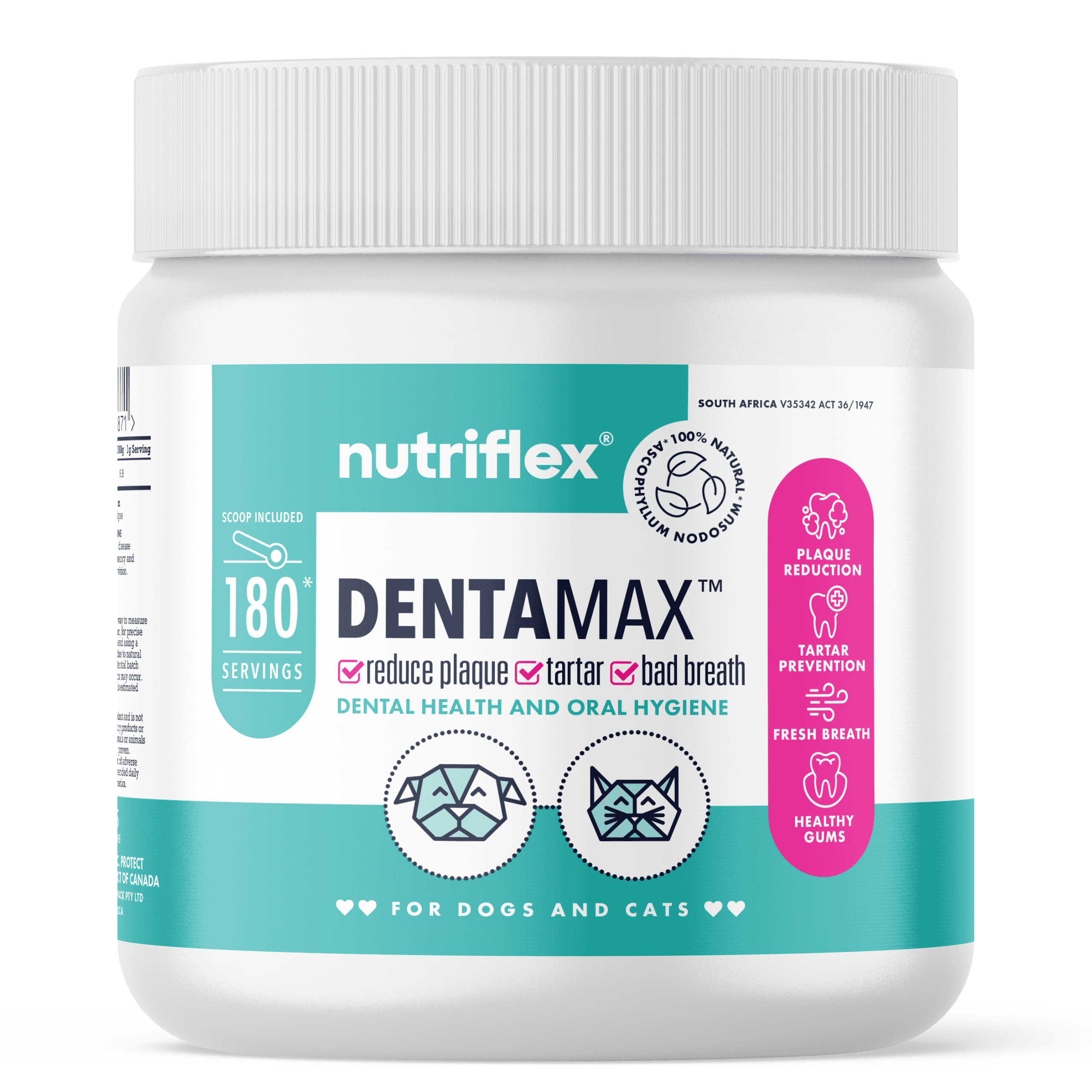
DentaMax™ Dental Powder for Dogs and Cats
DentaMax™ dental powder was developed as a daily oral health supplement designed to support plaque and tartar management in dogs and cats.
The formulation focuses on ingredient-driven dental support rather than harsh antiseptic chemicals or synthetic additives.
When used consistently, DentaMax™ helps support:
-
plaque management
-
tartar control
-
fresher breath
-
healthier gums
Because the powder is simply added to food, it provides daily dental support without brushing or specialised treats.
This makes it an easy addition to a dog’s daily feeding routine.
Why Daily Plaque Control Is Essential
Plaque begins forming again within hours after it is removed.
Because of this, dental care must be consistent.
Irregular dental care allows plaque to accumulate and eventually harden into tartar.
Daily plaque management is the most effective strategy for preventing long-term periodontal disease.
The Bottom Line: Does Kibble Clean Dog Teeth?
Standard kibble does not reliably clean dog teeth.
Although dry dog food is often believed to reduce plaque buildup, most kibble breaks apart too quickly to create meaningful friction against the tooth surface.
Dental health in dogs depends on consistent plaque management rather than diet alone.
Combining good oral hygiene habits with practical daily solutions such as dental powders can help support healthier teeth and gums over the long term.